The key point in one line: In its 2026 final opinion, the EU Scientific Committee on Consumer Safety (SCCS) assessed micron-sized particulate silver as safe at up to 0.2% in rinse-off products and 0.3% in leave-on products.[1] However, this conclusion is neither a blanket approval of all ‘silver cosmetics’ nor a finding that can be applied directly to spray products or nanoscale silver.
What exactly is the ‘silver’ evaluated by the SCCS?
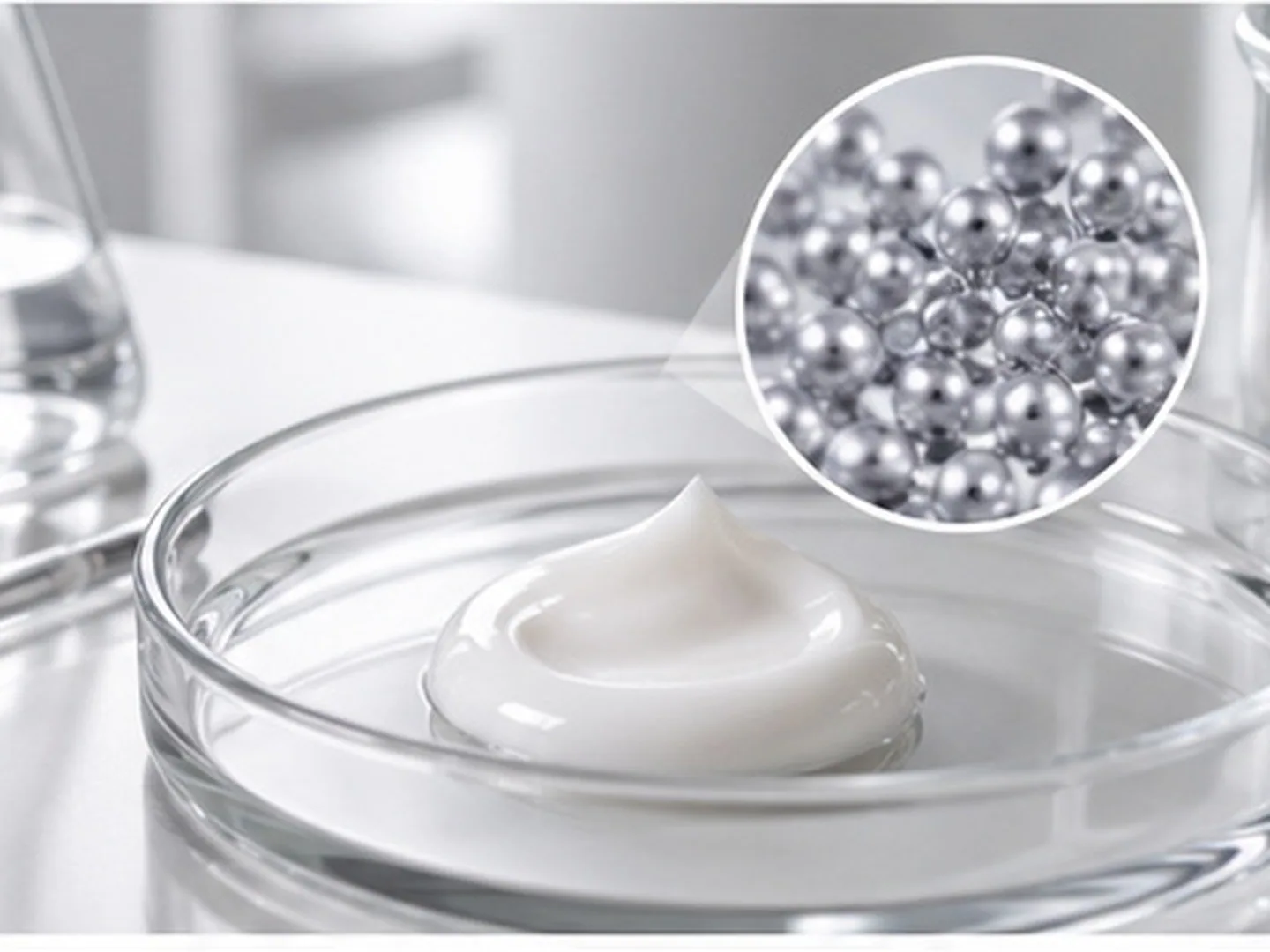
The opinion concerns ‘micron-sized particulate Silver’ with particle diameters greater than 100 nanometers and less than 1 millimeter.[1] The presence of the word Silver in a name does not mean that colloidal silver, nano-silver, silver salts, and other forms should be treated as the same substance. Differences in particle size and chemical form may also lead to differences in skin penetration and exposure patterns.
What do 0.2% for rinse-off products and 0.3% for leave-on products mean?
In its new assessment, the SCCS concluded that the micron-sized silver was safe at up to 0.2% in rinse-off products and up to 0.3% in leave-on products, taking into account data indicating that it does not pass through the skin.[1] Rinse-off refers to products that are washed away, while leave-on refers to products, such as creams, that remain on the skin after application.
Oral-hygiene products were assessed at up to 0.2%, and nail products at up to 0.3%; the same concentrations were considered safe for products intended for children. However, a separate maximum of 0.05% was given for children’s mouthwash.[1]
Why can’t the same conclusion be applied to spray products?
The SCCS explicitly stated that spray products using propellant gases were excluded from the assessment because they were not covered in the submitted materials.[1] This does not mean that ‘sprays are dangerous’; it means that their safety, including inhalation exposure, cannot be determined from this opinion alone.
Does ‘does not pass through the skin’ mean it has no effect?
No. Safety and efficacy assessments address different questions. Data indicating low skin penetration are important when assessing the risk of systemic exposure, but they do not automatically substantiate specific marketing claims concerning antibacterial, sebum-control, or preservative effects. An ingredient-level safety opinion should not be expanded into efficacy claims for a finished product.
What should consumers check on an ingredient list?
1. Do not infer whether it is nano-sized from the name ‘Silver’ alone
It may be difficult to determine both particle size and form from the ingredient name alone. In particular, nanomaterials may be subject to separate labeling requirements under EU regulations, so it is preferable to check both the product label and the manufacturer’s information.
2. Consider the product format
When the area and route of exposure differ—as with creams, cleansers, nail products, and oral-care products—the conditions of the safety assessment also differ. Even at the same concentration, formats with potential inhalation exposure, such as sprays, may require a separate assessment.[1]
3. Distinguish ‘antibacterial’ language from skin-improvement claims
The antibacterial properties of a cosmetic ingredient do not in themselves mean that it treats acne or skin disease. Once a product claims to treat a disease, the regulatory boundary between cosmetics and medicinal products may also change.
Frequently asked questions
Are silver cosmetics safe for all pregnant women and children?
That cannot be generalized. The SCCS opinion is an assessment based on a specific particle size and concentration, and on particular product types.[1] Actual products contain other ingredients as well, and the assessment should include individual allergies, skin conditions, and the area of use.
If the SCCS says it is safe, is more better?
No. A safe maximum concentration is not the concentration with the greatest efficacy. When choosing cosmetics, consumers should consider the intended function, the full formulation, sensory properties, and the potential for irritation together.
DERME VERDICT
The core message of the SCCS’s 2026 opinion is not that ‘silver ingredients are safe,’ but that particulate silver of a specific size was assessed at specific concentrations in specific product types.[1] Consumers will read the issue more accurately by distinguishing particle form, product type, concentration, and evidence from the actual finished product, rather than focusing on the ingredient name alone.