The European Commission’s Scientific Committee on Consumer Safety (SCCS) did not consider even the use of Basic Blue 99 at 1% in non-oxidative hair dye to be safe. Across the submitted data, it could not rule out genotoxicity—the possibility of damage to genetic material. This conclusion, however, should not be broadened to mean that all blue or blue-black hair dyes are dangerous. [1]
The subject of this assessment is not a color but a specific dye with CAS No. 68123-13-7. Even products in the same blue-black category may use different colorant combinations. Rather than intensifying fear based on the color name, consumers should look in the finished product’s full ingredient list for Basic Blue 99 or CI 56059. [1][2]
What is Basic Blue 99?
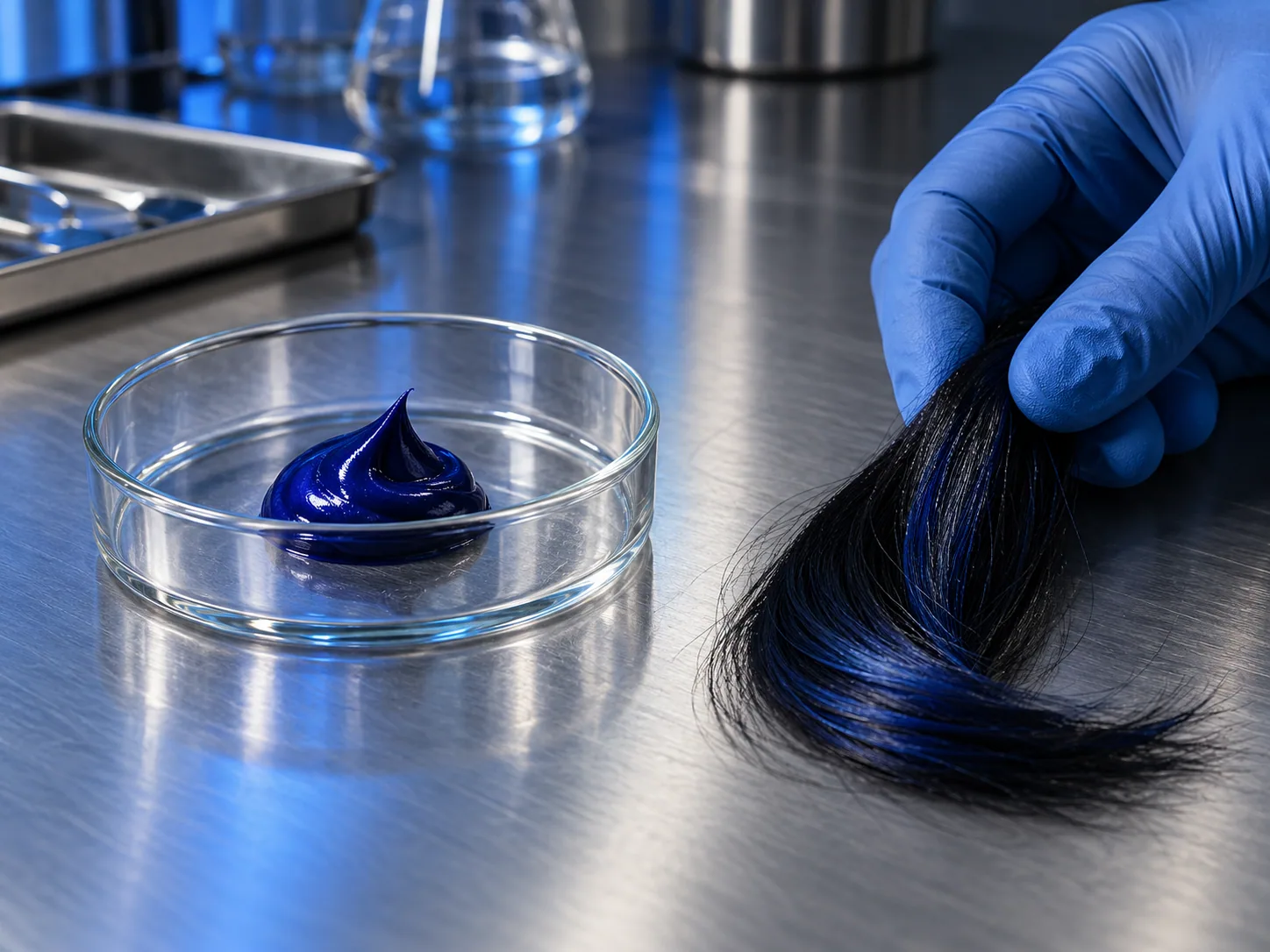
Basic Blue 99 is a positively charged dye that may be used to add blue tones to hair. Unlike oxidative hair dyes, which create color through an oxidation reaction involving hydrogen peroxide and dye precursors, non-oxidative hair dyes are products in which an already-colored dye adheres to the hair. It may be found in color treatments or direct-dye products, but it is not present in every non-oxidative product.
The name of a raw material and the name of a finished product are different. Even when the front of a package says “ash,” “navy,” or “blue-black,” the ingredient combination varies by brand and product. The Korean Cosmetic Association’s Ingredient Dictionary provides the ingredient name and CI 56059 identification information for Basic Blue 99. [2]
Why did the SCCS decide that even 1% was not safe?
The SCCS adopted its final opinion on February 2, 2026, and published it on February 10. The question was whether Basic Blue 99 was safe for use at 1% in non-oxidative hair dye. After reviewing the available data, the committee did not consider it safe because of its potential genotoxicity. [1]
“Potential genotoxicity” is not a clinical prediction that users will immediately develop cancer. Genotoxicity is a hazard characteristic assessed through testing for the possibility of damage to DNA or chromosomes. If this concern is not adequately resolved, it becomes difficult to establish a safe exposure limit by calculating how little is absorbed through the skin. The key point of this assessment, therefore, is that a seemingly low figure such as 1% cannot by itself justify reassurance.
Does this result apply to all blue-black hair dyes?
No. An ingredient assessment should not be generalized to an entire color category. Products without Basic Blue 99 are not the direct subject of this specific conclusion. Conversely, a product does not have to emphasize blue on the front of the package to be relevant if it contains the ingredient. The INCI ingredient list is more reliable than a color photograph.
Raw-material testing and experience with a finished product must also be distinguished. A finished product involves variables such as concentration, other dyes, solvents, pH, and application time. The SCCS’s 1% assessment is a scientific opinion based on specific conditions of use and the submitted raw-material data. It does not automatically conclude that a different concentration or different ingredient is safe or dangerous.
Are skin allergy and genotoxicity the same issue?
No. Skin sensitization is the tendency of the immune system to react after repeated exposure, causing allergic contact dermatitis such as itching, redness, or swelling. The SCCS considered Basic Blue 99 to be a skin-sensitizing substance and also noted concern about signs of immediate hypersensitivity reactions, although the precise composition of some batches was uncertain. [1]
Genotoxicity concerns the possibility of damage to genetic material in cells, while skin testing primarily examines the likelihood of visible irritation or an allergic reaction. Therefore, a lack of reaction in a pre-use patch test does not resolve concerns about genotoxicity. The two questions involve different endpoints.
What should you check at home?
1. Check the full ingredient list before the product name
Check the packaging or product page for Basic Blue 99, CI 56059, or the relevant CAS number. If the ingredient list is provided only as an image and is difficult to search, give the manufacturer the product name and lot number and request a written response. Ingredient lists from old reviews may predate a reformulation, so use the current packaging as your reference.
2. Check local regulations and the manufacturer’s actions separately
The SCCS opinion provides a basis for EU risk assessment, but it should not be interpreted to mean that all products have been immediately recalled in South Korea. Check the regulatory authority’s notices in the country of sale, the manufacturer’s latest notices on ingredient changes or recalls, and the actual product lot separately. Do not rely solely on a seller’s claim that a product “meets European standards” when its regulatory status is unclear.
3. Follow allergy precautions separately
The U.S. FDA advises performing a skin test according to the product directions each time you color your hair and following the instructions’ warnings and specified timing, wearing gloves, and rinsing thoroughly. Do not mix two products arbitrarily or color hair on a scalp with irritation, wounds, or sunburn. [3]
When should you seek medical care if a reaction occurs?
If itching, oozing, or a burning sensation on the scalp develops, rinse thoroughly immediately and stop using the product. Swelling of the face or eyelids, difficulty breathing, dizziness, or generalized hives are signs requiring emergency evaluation. Once the reaction has subsided, do not test the same product again; discuss formal patch testing with a dermatologist to identify the causative ingredient.
Frequently asked questions
Q. Is a “ammonia-free” product unrelated to Basic Blue 99?
Not necessarily. An ammonia label provides information about the alkaline-agent formulation, while whether Basic Blue 99 is included is a separate question. Check the full ingredient list directly.
Q. Are salon products safer than those for home use?
Professional application offers the advantage of having use and contact time managed by an expert, but it does not automatically eliminate ingredient-related risks. Share the product name, full ingredient list, lot number, the salon’s skin-testing policy, and your history of allergies with your stylist.
Q. Do I need to avoid all blue hair dyes?
There is no need to do so. This opinion concerns a specific ingredient. Look for alternatives without Basic Blue 99, and check the label and directions because other dyes may also involve separate allergy or regulatory issues.
DERME VERDICT | Look at the CAS number, not the color name
The important point in this news is not “blue-black panic,” but that the uncertainty surrounding one raw material was not concealed. The color name on the front, a patch test, and a regulatory opinion provide different information. The most practical basis for a purchase is to check the full ingredient list for Basic Blue 99, follow allergy precautions separately, and compare the latest country-specific notices with the product’s lot information.