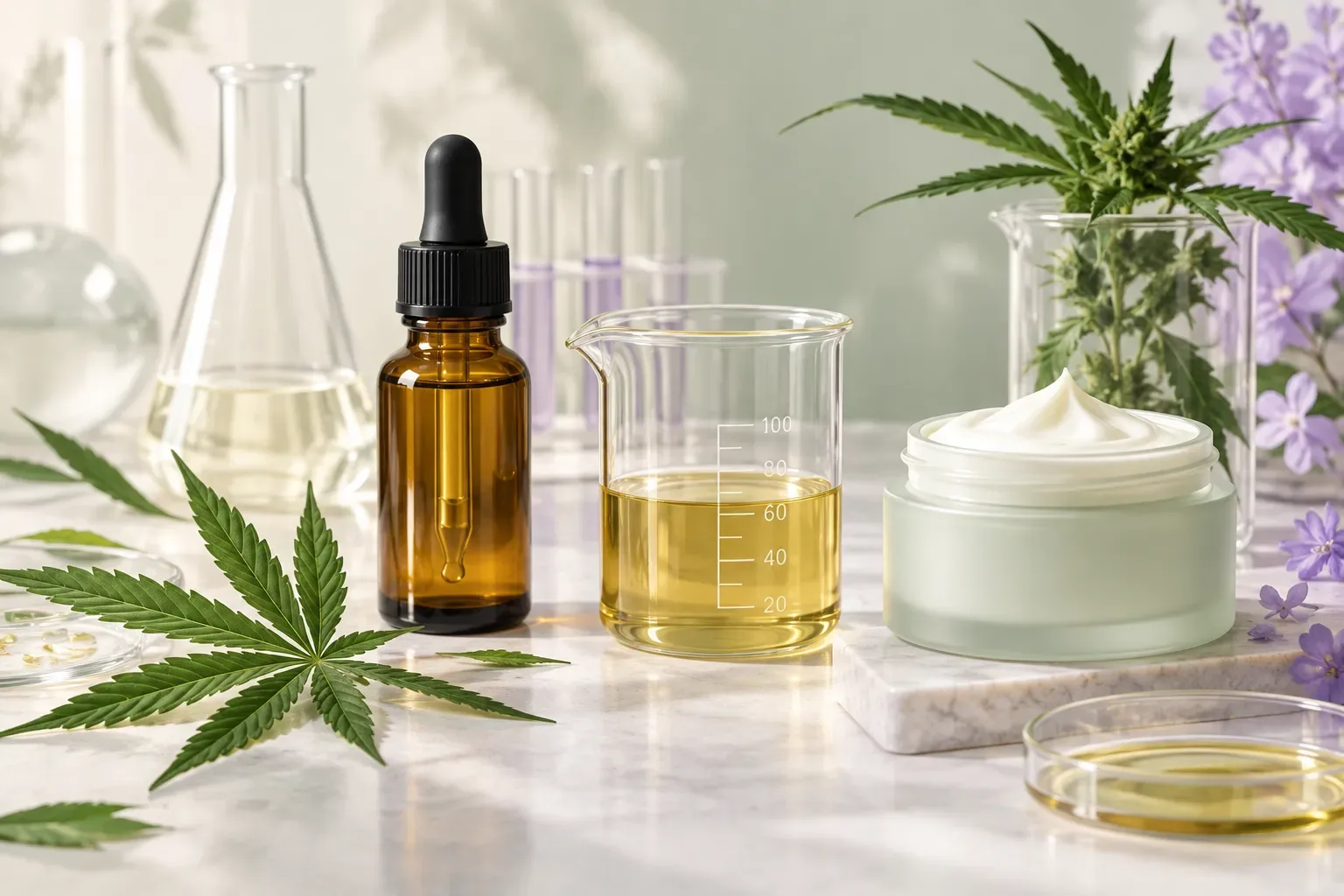
When choosing tea tree oil cosmetics, consumers often look first at “how many percent.” Yet in its 2025 final opinion, the European Commission’s Scientific Committee on Consumer Safety (SCCS) emphasized both concentration and finished-product stability. The number 0.1% in a face cream cannot, by itself, be interpreted as meaning that it is gentle enough for sensitive skin.[1]
Tea tree oil is an essential oil made up of multiple volatile components. Its composition can change when exposed to light, heat, air and moisture. One point worth knowing is that an ingredient-content specification shows the figure just after manufacturing; whether the same composition remains after opening is a matter of the container, storage and stability testing.
Why 2% in shampoo is different from 0.1% in face cream
The SCCS judged tea tree oil safe for adults at up to 2.0% in shampoo, 1.0% in shower gel, 1.0% in face cleanser and 0.1% in face cream across four product types used on the skin.[1] Rinse-off and leave-on products are not assigned the same maximum concentration because the time and amount of skin exposure differ.
This conclusion is not a blanket authorization for all tea tree oil cosmetics. It applies only to the four evaluated product types that match the specified ISO composition, are intended for adults and are applied to the skin. Formulations that may create inhalation exposure, such as sprays or aerosols, were not included.[1] The findings on the ingredient should not be extended to sprays, high-concentration spot oils or children’s products.
What the phrase “natural antibacterial” overlooks about sensitization
Sensitization refers to the possibility that, after repeated exposure, the immune system recognizes an ingredient as a threat and causes allergic contact dermatitis. Based on the submitted data, the SCCS considered tea tree oil a moderate skin sensitizer.[1] Being naturally derived does not eliminate the possibility of an allergy.
Brief stinging is not the same as an allergy. If itching, redness, swelling or small blisters spread beyond the application site or recur, stop using the product and keep the ingredient list and the product. Applying another essential oil before the inflammation settles can make it difficult to identify the cause.
How can consumers assess finished-product stability?
The SCCS noted that the submitted materials contained no stability data for tea tree oil under storage and use conditions. Its view was that, because the composition can change with exposure to light, heat, air and moisture, the finished product should be managed to maintain the ISO 4730 specification.[1] Consumers may find it difficult to verify test reports directly, but they can check for opaque containers or packaging that limits air contact, a clearly stated period after opening and storage instructions.
Avoid storing it on a bathroom windowsill or in a hot car. Do not continue using a product on the face if its scent has become unusually sharp, its color has changed or old residue has built up around the cap. If pure oil is mixed into a cleanser or cream on the spot, the final concentration and dispersion cannot be known, so measuring by “one drop” is difficult to treat as a safety standard.
If you have acne-prone skin, can tea tree oil be considered a treatment?
Cosmetic claims about sebum or antibacterial effects should not be equated with acne-treatment efficacy. Human studies of finished products and evidence for medicines must be distinguished. If red, painful inflammatory lesions recur or scarring develops, considering standard acne treatment is preferable to increasing the concentration of tea tree oil.
DERME VERDICT | Read beyond the concentration to the product’s lifespan
Before buying, check the product type, concentration and whether it is a spray. After opening, follow the storage instructions and note changes in scent or color. If you have sensitive skin, first apply it to a small area along the jawline and expand the area only if there is no reaction. The number attached to tea tree oil is only a starting point. The better question is whether the finished product maintains the same composition to the end.