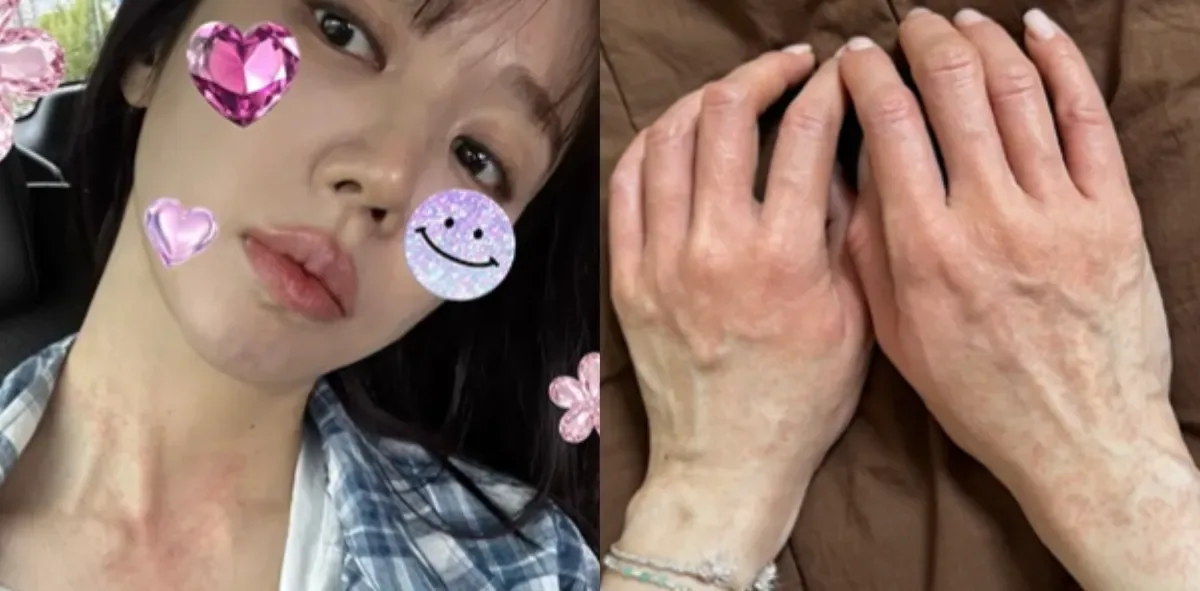
Actress Yoon Eun-hye recently shared on her YouTube content that she had received treatment for severe allergy symptoms. According to what she disclosed, her hands initially became severely swollen, red, and itchy, after which the symptoms spread to her neck, the tops of her feet, the area around her mouth, and beneath her eyes. She also personally showed photographs from the time when even the joints of her fingers had swollen.
The important point here is not to diagnose Yoon Eun-hye’s exact condition or its cause from photographs or videos alone. Nor can it be determined from the publicly available information whether a particular cosmetic, food, or medication was responsible. This column does not address Yoon Eun-hye’s personal diagnosis; instead, it explores a reader’s question from a dermatological perspective: why do red or brown marks remain after severe skin inflammation has passed?

Skin Can Retain Color After Inflammation
It is common for brown marks to remain where acne has subsided, or for an insect bite to turn dark after repeated scratching. An area may also remain darker for a long time after contact dermatitis or eczema has settled. A representative reaction is post-inflammatory hyperpigmentation (PIH).
PIH can occur when melanin production and distribution change after skin inflammation or injury. A 2024 systematic review concluded that PIH commonly develops after inflammatory skin conditions and may be more common in people with darker skin tones. However, its course and response to treatment vary depending on the cause and depth of the PIH and the individual’s skin tone.
Red and Brown Marks Are Not the Same Problem
When redness or a pinkish color remains after inflammation, vascular changes may play a larger role. When the mark is brown or dark brown, PIH involving melanin should be considered. In actual skin, the two changes may also appear together. Therefore, rather than applying the same treatment based only on the single word “mark,” it is important to assess the current inflammation, vascular redness, depth of the pigmentation, and skin tone together.
While the Skin Is Itchy and Red, Stabilizing Inflammation Comes Before Brightening
If the skin is still itchy, red, or burning, or if new rashes are developing, pigmentation is not the priority. First, the cause of the ongoing inflammation should be identified and treated. Adding multiple scrubs, strong exfoliants, or high-concentration active ingredients in the hope of brightening the skin quickly can cause irritation and trigger further inflammation.
Home care is better kept simple. Wash gently with lukewarm water, support barrier recovery with a low-irritation moisturizer, and reduce scratching or rubbing. If a rash of unknown cause recurs or spreads, diagnosing the condition should take priority over cosmetic treatment.
Once Inflammation Has Settled, Start with Sun Protection
Photoprotection is repeatedly emphasized as a basic measure in the literature on PIH treatment. A 2021 systematic review of topical treatments also found that sunscreen with an SPF of 30 or higher was recommended in nearly all studies. Repeatedly exposing pigmented skin to ultraviolet light while relying only on brightening products or lasers is not efficient.
Once the skin has stabilized sufficiently, evidence-based topical ingredients such as niacinamide or retinoids may be considered depending on the condition of the skin. The important thing is not to start several ingredients at once, but to add them one by one and check whether the skin can tolerate them. Stinging, dryness, and recurring inflammation can instead make pigmentation management more difficult.
When Should Lasers Be Considered?
The fact that pigmentation has persisted for a long time does not mean that laser treatment is immediately the right answer in every case. A 2024 systematic review of PIH treatments examined 41 studies involving 877 people. Lasers and energy-based devices, topical treatments, and combination treatments each showed improvement in some patients, but complete resolution was limited. Cases in which PIH actually worsened were also reported among those treated with lasers or energy-based devices.
Accordingly, the key to laser treatment is not “more aggressively,” but appropriate patient selection, timing, and energy settings. First, clinicians assess whether inflammation remains, the patient’s skin tone and the depth of the pigmentation, and whether pigmentation developed after previous laser treatment. In general dermatology practice, treatments such as picosecond devices or low-fluence toning may be selected depending on the condition, but treatment outcomes cannot be predicted from the name of a device alone.
Can Laser Treatment Actually Make the Skin Darker?
It can. Because lasers and energy-based devices intentionally stimulate the skin, inflammation after treatment can lead to PIH in some patients. A 2026 systematic review and network meta-analysis on preventing PIH after laser and energy-based treatments likewise treated PIH as an important post-treatment adverse event and compared preventive strategies.
Once My Skin Has Calmed Down, Can I Use Several Brightening Products Together?
Starting with several overlapping active ingredients is not recommended. It is safer to begin one ingredient at a low frequency and observe the skin’s response. Products with a potential for irritation, such as retinoids or acids, can cause renewed inflammation if used too aggressively before the skin barrier has recovered sufficiently.
When Should You See a Dermatologist?
If persistent pigmentation is a concern, a dermatologist can assess its cause and depth. By contrast, rapidly worsening swelling or swelling of the lips, tongue, or throat accompanied by difficulty breathing requires immediate medical evaluation, independently of the pigmentation issue. Recurrent rashes and itching of unknown cause should likewise be evaluated as a medical condition before cosmetic procedures are considered.
Dr. Kang Jeong-ha’s Recommendations
First, while the skin is red, itchy, and swollen, stabilizing inflammation is the top priority, not pigmentation treatment. Keep cleansing and moisturizing simple, and do not add scrubs, strong exfoliants, or several new high-performance products at once. Second, once the inflammation has subsided, make daily sun protection the foundation and begin topical pigmentation care one product at a time, as the skin can tolerate it. Third, if pigmentation persists despite lifestyle measures and topical care, have a dermatologist assess its depth and your skin tone, then selectively consider one or two treatments, such as a picosecond device or low-fluence laser toning.
The official information provided by Seolreim Clinic confirms that pigmentation treatment is offered as one of its treatment areas. However, a clinic’s list of services confirms what it offers; it is not independent clinical evidence guaranteeing effectiveness for a particular patient. When active allergies or dermatitis remain, stabilizing the underlying condition takes priority over cosmetic injections such as Rejuran or aqua injections.
Once the skin has become highly sensitive, following the proper order is more important than doing more. Stop the inflammation, care for the barrier and protect against ultraviolet light, and treat only the remaining pigmentation at the end. These three steps are a practical approach that can support recovery while reducing unnecessary irritation.
Sources
[6] Seolreim Clinic · Information on medical staff and treatment areas · accessed 2026-09-24

Interesting Dermatology Stories for Healthy Skin
Drawing on 16 years of experience running Seolreim Clinic in Gangnam, Dr. Kang Jeong-ha presents practical skincare methods for everyday life, along with engaging and accessible stories about dermatology inspired by celebrities, public figures, and television. Through professional knowledge and experience, the series aims to help your skin look healthier and more radiant. We hope it broadens your understanding of skin and helps you discover ways to care for yourself.
Dr. Kang Jeong-ha, Medical Director (Seolreim Clinic Gangnam)
- Source
- [1] 뉴시스·윤은혜, 온몸에 번진 알레르기…2주 동안 링거 맞아·2026-09-23
- [2] Journal of the European Academy of Dermatology and Venereology·Post-inflammatory hyperpigmentation: A systematic review of treatment outcomes·2024-03
- [3] Journal of Cutaneous Medicine and Surgery·Treatment of Post-Inflammatory Hyperpigmentation in Skin of Colour: A Systematic Review·2024-09
- [4] Dermatologic Therapy·Topical treatment for postinflammatory hyperpigmentation: a systematic review·2021
- [5] Lasers in Surgery and Medicine·Interventions to Prevent Postinflammatory Hyperpigmentation After Laser and Energy-Based Device Treatments·2026-03
- [6] 설레임의원·의료진 및 진료 분야 안내·확인 2026-09-24