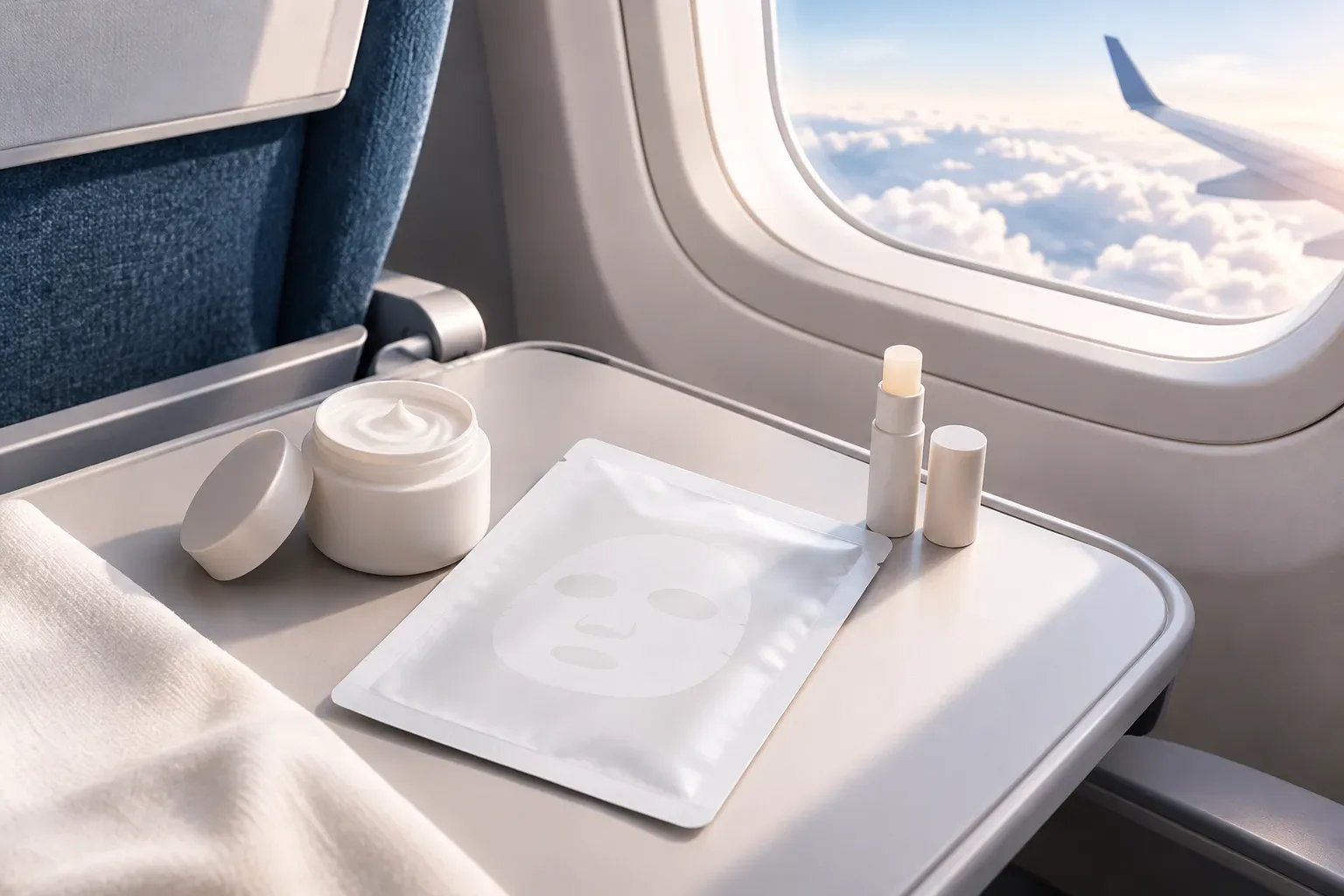
In a Vogue interview published on October 20, 2026, Kendall Jenner said that using a face mask toward the end of a flight makes her skin feel more hydrated.[1] The method may help with a quick refresh just before landing, but one mask is not a solution for the dryness caused by a long-haul flight.
The article also indicates that the discussion appears in the context of a specific brand collaboration.[1] For that reason, it is more useful to take away the timing than the product name. The key to caring for skin during a flight is to prevent moisture loss before boarding, reapply familiar moisturizer in the cabin while maintaining hand hygiene, and restore the skin barrier after arrival.
How quickly does skin moisture decrease after boarding?
In a study observing long-haul flight conditions, the cabin’s relative humidity fell below 10% within two hours of takeoff, and moisture indicators in the stratum corneum of the face and arms decreased. A reduction of up to 37% was observed on the cheeks.[2] Because the study was a small observational study under specific flight conditions, the same figures cannot be applied to every passenger.
This refers to moisture in the skin’s surface stratum corneum. Feeling tightness during a flight does not immediately mean that the body as a whole is severely dehydrated. Drinking an appropriate amount of water and creating a moisturizing film on the skin’s surface are separate matters.
Is it best to use a face mask just before landing?
If it is an unscented sheet mask that has worked well for you before, using it briefly for 20–30 minutes before landing may help smooth the surface of the skin before makeup. However, do not leave the mask on until it dries. After removing it, apply a thin layer of cream to reduce renewed moisture loss.
Touching the face with dry hands at your seat, rather than freshly washed hands from the cabin lavatory, may instead increase irritation and contamination. If it is difficult to clean your hands or you are trying a product for the first time, reapplying a moisturizer from a tube is simpler and more predictable than using a face mask.
The moisturizing routine before boarding, in the cabin, and after arrival can be simplified as follows
Before boarding: prevent evaporation rather than simply adding moisture
After gentle cleansing, apply a cream while the skin is still slightly moist, choosing one containing moisturizing ingredients such as glycerin and hyaluronic acid, along with barrier-supporting ingredients such as ceramides, dimethicone, and petrolatum. The American Academy of Dermatology also advises applying a cream or ointment moisturizer before the skin dries after washing.[3]
In the cabin: do not experiment with new ingredients
Take a break that day from retinoids, high-concentration acids, scrubs, and samples you have never used before. In a dry environment, ingredients that your skin normally tolerates may also feel irritating. Apply a thin layer of a familiar cream or ointment to areas that feel tight, and use a petrolatum-based protectant on the lips.
After arrival: cleanse, soothe, and return to your usual routine
Remove dust and sunscreen with lukewarm water and a gentle cleanser, then moisturize again while the skin is still moist. Rather than immediately scheduling an aggressive peel or laser treatment, wait a day or two to see whether redness and stinging subside.
How can you distinguish simple dryness from dermatitis?
If tightness and fine flaking quickly improve after moisturizing, the condition is more likely to be temporary dryness. However, if there is severe itching, spreading red patches, or swelling and oozing around the eyelids or lips, contact dermatitis or a flare-up of an existing skin condition should be considered. In that case, stop using the suspected product and seek a dermatological diagnosis rather than adding another face mask.
Are injectable treatments a quick solution for flight-related dryness?
Injectable treatments containing hyaluronic acid or PN/PDRN may be presented as targeting improvements in skin texture or moisture, but they are not moisturizers that can immediately reverse dryness after landing. Seolleim Clinic currently offers the Super Miracle Water Glow Injection and describes a combination of PDRN, hyaluronic acid, and vitamins.[4] This page serves as evidence of the treatment’s availability and the clinic’s description, not as independent proof of efficacy.
Small bumps, swelling, bruising, and pain may occur after injections, and rare risks such as infection and vascular complications must also be considered. Rather than choosing the treatment on a tightly scheduled day before or after a flight, first check that there is no dermatitis and allow enough time for recovery.
Is it okay to keep spraying mist during the flight?
If you spray only mist and let it dry, the moisture may evaporate and the skin may feel tight again. If you use it, do not rub it in; gently press it into the skin, then apply a small amount of cream over it.
Which products should you avoid when using a face mask in the cabin?
Avoid products you have never used before, strongly fragranced products, and those containing acids, retinoids, or high concentrations of essential oils. An unscented moisturizing product that you have already tested at home is the safer choice.
Dr. Kang Jung-ha’s recommendations
First, after gentle cleansing before boarding, apply a ceramide cream to moist skin; in the cabin, wash your hands and reapply only the same product to areas that feel tight. Second, if you want to use a face mask before landing, use an unscented product that you already know suits you for just 10–15 minutes, then finish with cream. Third, skip retinoids and exfoliation on the day you arrive, and observe whether redness and itching subside.
If dryness and concerns about fine lines and texture remain after two to four weeks of consistent moisturizing, and there is no dermatitis, you can compare a hyaluronic-acid-based skin booster injection or a PN-based skin booster after receiving a diagnosis. The priority is first to rule out disease and restore the skin barrier; injectable treatment comes afterward. When making a choice, check the ingredients, dosage, injection depth, duration of bruising and swelling, and response to infection.
Rather than filling your flight bag with multiple samples, pack one cream and one lip balm that you have already tested at home. Skin during a long-haul flight remembers an uninterrupted, thin moisturizing film for longer than an elaborate regimen.

Engaging Skin Stories for Healthier Skin
Drawing on 16 years of experience running Seolleim Clinic in Gangnam, Dr. Kang presents practical skincare methods for everyday life, along with approachable and engaging stories about dermatology inspired by celebrities, public figures, and television. Through professional knowledge and experience, the aim is to help your skin look healthier and more beautiful. Through this series, we hope you will broaden your understanding of skin and discover ways to care for yourself.
Dr. Kang Jung-ha, Medical Director (Seolleim Clinic Gangnam)
- Source
- [1] Vogue · Kendall Jenner’s Simple Approach to Skin Care and Life · 2026-10-20
- [2] Skin Research and Technology · Skin surface hydration decreases rapidly during long distance flights · 2012
- [3] American Academy of Dermatology · Dermatologists’ top tips for relieving dry skin
- [4] Seolleim Clinic · Official information on the Super Miracle Water Glow Injection