Horizontal neck lines visible since childhood are not a verdict that “aging came early.” Moisturizers or eye creams can smooth a surface roughened by dryness, making fine lines appear less pronounced, but it is difficult for a single product to eliminate deep-set horizontal lines, vertical neck bands, or skin laxity that are already established.[1][2]
In a Vogue “Beauty Secrets” video released on January 26, 2026, actress Yerin Ha said that she also applies eye-area serum to her neck. She went on to explain that although she had been self-conscious about the lines on her neck from a young age, she had come to reflect on the influence of genetics and self-acceptance.[1] The video did not disclose any history of specific procedures, and treatment or disease should not be inferred from her appearance. Still, it clearly raises a question many readers have: What changes when you apply a facial product to the neck as well?

Why can horizontal neck wrinkles appear even when you are young?
Horizontal neck lines can reflect a combination of the direction in which the skin repeatedly folds, innate anatomical structure, skin thickness and elasticity, and ultraviolet exposure. Looking down at a smartphone can make the lines more noticeable, but explaining every horizontal neck wrinkle as “tech neck” is overly simplistic. If the same lines appear in childhood photographs, that is a strong clue that structural predisposition plays a substantial role.
By contrast, bands that protrude vertically when you tense your neck may be related to the platysma—the thin, broad muscle at the front of the neck. Submental fat, skin laxity, pigmentation, and rough skin texture are also separate concerns. Seolreim Clinic’s official guidance likewise distinguishes vertical bands from horizontal neck wrinkles, noting that neck botulinum toxin does not address both horizontal lines and excess skin.[3]
What actually improves when you apply eye cream to the neck?
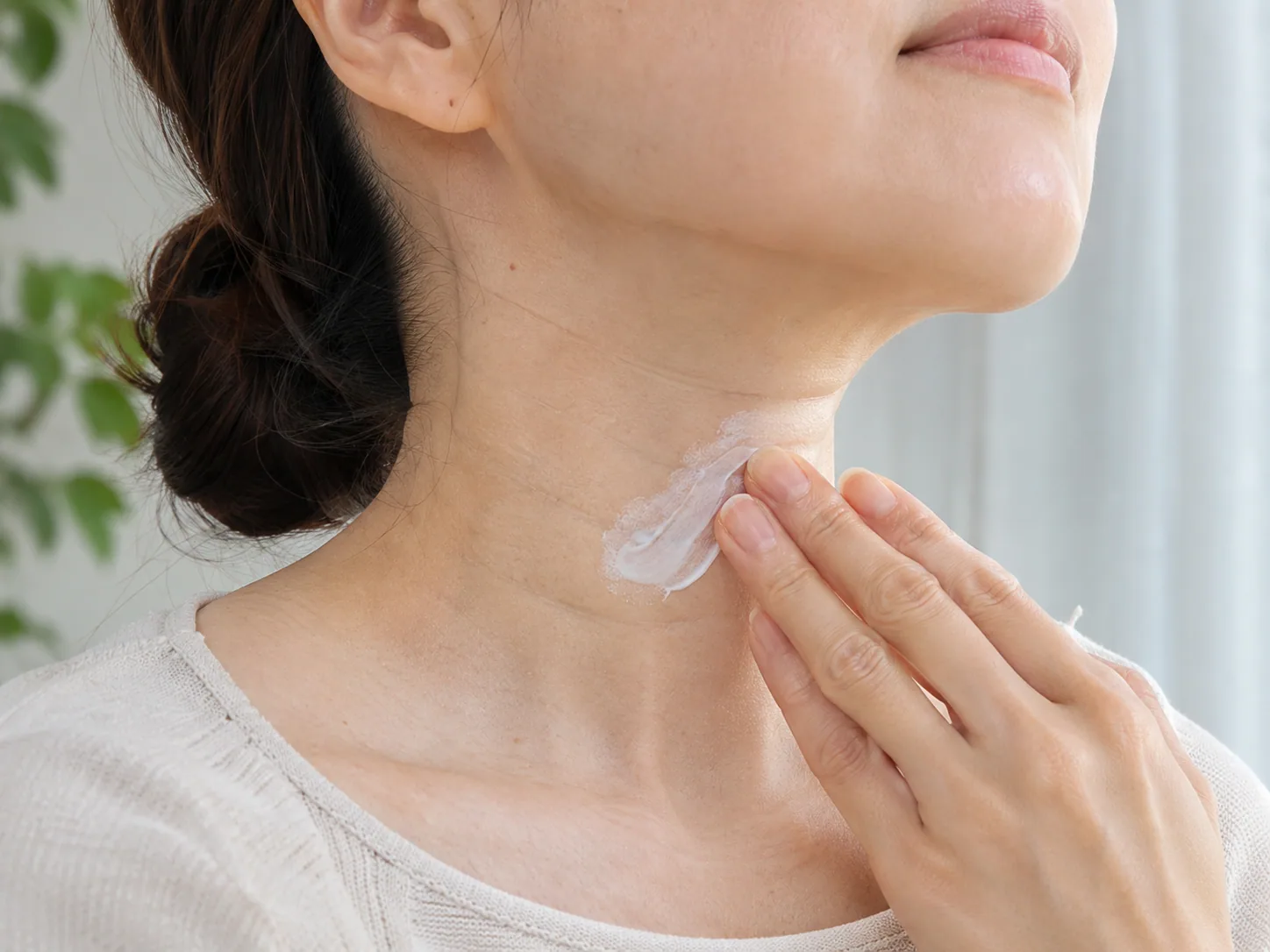
The name “eye cream” itself does not guarantee any special benefit for the neck. Moisturizing ingredients can help the skin retain water, temporarily making fine lines look plumper and smoother. The American Academy of Dermatology also explains that moisturization may help reduce the appearance of some fine lines.[2] Ultimately, the ingredients, potential for irritation, and sensory feel matter more than the product name.
Even retinol or acids that suit your face can cause stinging and redness on the neck. Neck skin is repeatedly exposed to friction, fragrance, and clothing collars. Start new active ingredients on a small area and at a low frequency; discontinue use if burning persists. Retinoids should be avoided during pregnancy.[4]
How do treatment options differ for horizontal lines, vertical bands, and sagging?
If horizontal lines are the main concern, the skin surface and wrinkle grooves are assessed. A 2026 systematic review found more studies on hyaluronic acid fillers for horizontal neck lines than on botulinum toxin, with relatively consistent evidence of improvement. However, only 12 studies were included, and direct comparative trials were lacking, so it cannot be said that “fillers are the right answer for everyone.”[5]
For vertical bands, botulinum toxin may be considered after determining whether muscle activity is pronounced. The effect is temporary, and in the neck, risks such as difficulty swallowing, speaking, or breathing, as well as reduced neck strength, must be weighed particularly carefully.[3] For sagging and skin texture, energy-based devices or lasers may be considered, but rather than focusing on the device name, the target depth, recovery period, and risk of hyperpigmentation should be judged according to the condition of the skin.
As of the writing date, Seolreim Clinic’s official website lists Sylfirm, Cellre D.M., Baby Collagen Injection NECK, and skin Botox among its neck-care treatments.[6] This menu is evidence only that the clinic offers these procedures; it is not independent proof of their efficacy or safety. In particular, the effects of a program combining several procedures should not be generalized from research on a single ingredient.
What should you check in the mirror before consulting about neck lines?
Under the same lighting, take a photo from the front with your muscles relaxed, one with your neck slightly bent forward, and one showing the vertical bands while clenching your teeth or making an “ee” sound. Look through older photos to identify when the horizontal lines first appeared, and note any recent weight changes, sun exposure, or dermatitis. With these four pieces of information, it becomes easier to discuss what to address first—structure, muscle, or skin texture—rather than treating it as simply “one wrinkle.”
Can I apply facial retinol directly to my neck?
The fact that your face tolerated it does not mean your neck will tolerate the same frequency. For a dry or sensitive neck, start with moisturizer alone, and if needed, test it at a low strength and low frequency. Discontinue use if redness or stinging persists, and do not use retinoids during pregnancy.[4]
Will Botox smooth out horizontal neck lines too?
Because horizontal lines are not caused solely by muscle, it is difficult to expect botulinum toxin alone to smooth them completely. It may be a more direct treatment for vertical platysma bands, but horizontal lines require separate assessment of the skin grooves, elasticity, and structure.[3][5]
Dr. Kang Jung-ha’s recommendations
The first step is daily care. In the morning, apply broad-spectrum sunscreen to the front and sides of the neck along with the face, and at night, extend a moisturizer without a strong fragrance down to the neck. Reduce the amount of time spent with your neck fully bent while looking at a screen, but do not expect posture correction alone to erase genetically determined horizontal lines. Test a new retinol product on a small area, starting at a low frequency of no more than twice a week.[2][4]
The second step is identifying the target. For shallow dry lines, continue moisturizing and using sunscreen for 8–12 weeks first. If vertical bands that appear when you tense your neck are the main concern, consider botulinum toxin first, while receiving an explanation of the risks of swallowing or speech problems and reduced neck strength. If deep horizontal lines remain even at rest, treatment of the wrinkle groove, such as a small amount of hyaluronic acid filler, may be considered; however, ask about the possibility of bruising, swelling, and vascular complications, as well as the limitations of the research.[3][5]
If skin sagging and rough texture are the main concerns, radiofrequency microneedling such as Sylfirm, or other energy-based devices, may be options. We confirmed that Seolreim Clinic does offer the treatment, but the device, intensity, and number of sessions should be determined after an examination.[6] Rather than combining several procedures at once, it is easier to interpret the results and side effects by proceeding in this order: ① moisturization and protection ② identifying the direction of the lines ③ targeted treatment for the single greatest concern. Managing neck lines begins not with the single word “age,” but with reading the direction of the lines.

Engaging Dermatology Stories for Healthy Skin
Drawing on 16 years of experience running Seolreim Clinic in Gangnam and expertise in dermatological procedures, Dr. Kang Jung-ha explains practical skincare methods for everyday life, along with engaging and approachable stories about dermatology inspired by celebrities, public figures, and television. Through professional knowledge and experience, he aims to help your skin look healthier and more beautiful. We hope this series broadens your understanding of skin and helps you discover ways to care for yourself.
Dr. Kang Jung-ha, Medical Director (Seolreim Clinic Gangnam)
- Source
- [1] Vogue Beauty Secrets · Bridgerton Star Yerin Ha’s Skincare Routine Is a K-Beauty Bonanza · 2026-01-26
- [2] American Academy of Dermatology · Wrinkle remedies · accessed 2026-11-09
- [3] Seolreim Clinic · Botox for Vertical Neck Bands · Nefertiti Lift: Treatments Different from Those for Horizontal Neck Lines · revised 2026-10-27
- [4] American Academy of Dermatology · Retinoid or retinol? · accessed 2026-11-09
- [5] Journal of Cosmetic Dermatology · A Systematic Review of Injectable Treatment Options for Horizontal Neck Rhytides · 2026
- [6] Seolreim Clinic · SEOLREIM NECK CARE Official Website · accessed 2026-11-09