Like the mugwort mask Yerin Ha shared, using a well-tolerated product for 10–15 minutes can be both a skincare routine and a chance to slow down during the day. But for sensitive skin, “soothing ingredients” are not an insurance policy that becomes safer when layered in greater amounts. If itching, swelling or spreading redness appears, that is not the ingredients at work—it is a reaction that calls for stopping.
In a Vogue video released in January 2026, actress Yerin Ha said she used a mugwort mask for about 10–15 minutes and that it made her skin feel comfortable. She said she learned to make time for herself by watching her mother’s evening skincare routine, describing the time as “me time.”[1] This is Yerin Ha’s publicly shared personal routine, not clinical evidence of efficacy for all skin types. Her skin condition or treatment history should not be inferred from her appearance.
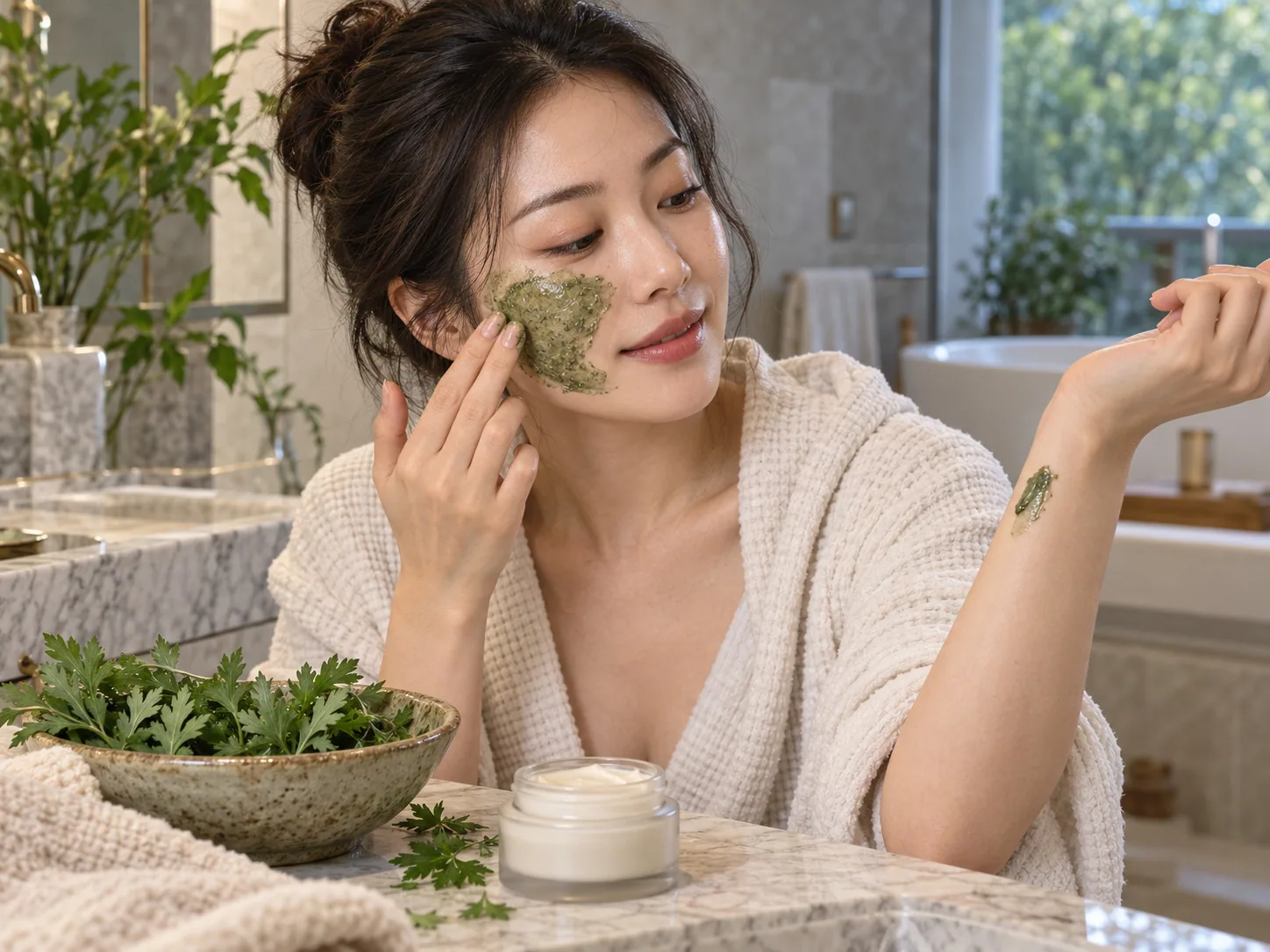
Why might a mugwort mask feel comforting?
Wash-off masks can help retain moisture on the skin’s surface and may temporarily make the skin feel hydrated and calmer by reducing temperature and friction during use. Mugwort refers to plant extracts from the Artemisia genus, but the species, extraction method, concentration, fragrance and preservatives vary by product. That is why findings about an ingredient cannot be presented as evidence of the finished product’s overall effects.
The comparison readers should remember is not “natural versus chemical,” but “a finished product my skin tolerates versus one it does not.” The American Academy of Dermatology notes that products containing plant-based ingredients may also contain fragrance-related ingredients and can cause allergic contact dermatitis.[2] It is not possible to identify at home, based on sensation alone, whether mugwort itself or another accompanying ingredient is responsible.
How are stinging, irritant dermatitis and allergic dermatitis different?
A reaction that stings briefly immediately after application and then disappears is common when the skin barrier is damaged, but that does not mean it is normal. If burning and dryness worsen in proportion to the amount used or the duration of use, irritant contact dermatitis should be considered. If itching, swelling, oozing or a rash spreading beyond the application area appears hours to days later, allergic contact dermatitis becomes more likely.
Cases of allergic contact dermatitis associated with mugwort have been reported, and patch-test data on plant extracts also show that “botanical” is not synonymous with non-allergenic.[3][4] However, a single case does not indicate the risk rate of all mugwort cosmetics. Pollen allergy and skin contact allergy are also not assessed with the same test, so if reactions recur, a medical patch test can help narrow down the cause.
How should sensitive skin test a new mask?
On a day without redness or itching, apply the finished product to a small area, such as the inner arm, according to the instructions, then wash it off. The American Academy of Dermatology recommends testing a new skincare product on a small area twice daily for 7–10 days.[2] With a wash-off product, leave it on for the same amount of time you would use it on your face, then rinse it off. Do not add several new products on the same day just because one application went well.
When first using it on the face, do not combine it on the same day with exfoliants, retinoids or high-concentration vitamin C. After the mask, apply just one moisturizer with a simple ingredient list. If it stings or itches, immediately rinse with lukewarm water, stop all new products, and return to a gentle cleanser, moisturizer and sunscreen. Adding “one more soothing mask for calming” can prolong the skin’s exposure to irritation.
What order should you follow to make your skin comfortable again in daily life?
Reduce your routine for the first 72 hours. In the morning, use only lukewarm water or a gentle cleanser, moisturizer and sunscreen. In the evening, use a cleanser and moisturizer with little fragrance and a simple ingredient composition. Put saunas, hot showers, scrubs, facial massages and alcohol on hold for a while, as they can intensify redness and heat.
Over the following two weeks, reintroduce only one product at a time and record photos and symptoms. If the eyelids or area around the mouth repeatedly swell, if there is oozing, or if itching interferes with daily life and sleep, medical evaluation and formal patch testing should take priority over a self-administered patch test.[2] While contact dermatitis is suspected, do not try to cover the redness with cosmetic injections or energy-based procedures.
When and what dermatological procedures can be considered?
During active inflammation, taking a break from procedures comes first. Treat the cause of the itching, oozing or burning first, then reassess the remaining concerns after the skin barrier has stabilized. It is necessary to distinguish whether dryness, persistent redness, or skin texture and elasticity is the main issue in order to avoid unnecessary combination procedures.
If dryness and fine lines remain after the inflammation has subsided, a hyaluronic acid–based hydration injection or the Super Miracle Glow Injection currently offered by Seolleim may be considered. Seolleim’s official information describes a combination of PDRN, hyaluronic acid and vitamins, as well as a return to daily activities on the same day.[5] However, a clinic menu indicates operational availability and treatment composition; it does not establish the independent efficacy of the entire combination program. Possible bruising, swelling, small bumps, infection risk and allergies to the ingredients should be checked first.
If skin texture and elasticity are the greater concern, Shining or Royal Rejuran, PN skin boosters, may be considered next once inflammation has stabilized. Seolleim’s official page notes bumps for one to two days after treatment and the associated recovery conditions.[6] A 2025 systematic review of PN and PDRN aesthetic procedures reported possible improvements in wrinkles, skin texture and elasticity across nine studies involving 219 people, but concluded that the quality of evidence was low to moderate, the methods varied, and there was insufficient consensus on optimal use.[7] Therefore, the effects reported in a single PN study should not be expanded to the overall effect of a clinic’s combination prescription.
Frequently asked questions
Can I find out at home whether I am allergic to mugwort?
Testing a small area at home can help determine whether you tolerate the finished product, but it cannot identify the causative ingredient. Recurrent itching, swelling or rashes are better evaluated with a dermatology patch test.[2]
Does leaving the mask on longer increase its soothing effect?
No. Leaving a product on beyond the stated time does not increase its efficacy proportionally. The skin may feel tight or become more irritated as the mask dries, so the context of Yerin Ha’s publicly shared 10–15-minute routine should be considered together with the product instructions.[1]
If I have redness, can I immediately get Rejuran or a glow injection?
If you have active dermatitis with itching, heat or oozing, avoiding the cause and receiving treatment come first. Once symptoms have stabilized, decide by separating the goals: hydration injections for dryness, and PN skin boosters for skin texture and elasticity.
Dr. Kang Jeong-ha’s recommendation
The order of action is simple. First, test a new mask on the inner arm for 7–10 days and use it on the face only for the stated amount of time. Second, if stinging or itching occurs, stop new products, including exfoliants and retinoids, and reduce your routine to cleansing, moisturizing and sun protection for 72 hours. Third, if the same area repeatedly swells or itches, record the product names and identify the cause through patch testing.
The procedure priorities are: ① no procedures during active inflammation; treat the condition first; ② once stabilized, consider a hyaluronic acid hydration injection or Super Miracle Glow Injection when dryness is the main concern; and ③ consider Shining or Royal Rejuran when skin texture and elasticity are the main concerns. Hydration injections may involve bruising, swelling, bumps and rare infection, while PN skin boosters may involve pain and bumps for one to two days.[5][6] Rather than layering several ingredients at once, treating the single greatest concern first and reassessing the response after two to four weeks makes it easier to distinguish cause from effect.
The lesson of the mugwort mask is not the trendiness of a particular ingredient, but the “pace of caring for myself.” On days when the skin feels comfortable, keep it as a short, enjoyable routine; on days when the skin is sending warning signals, stopping rather than applying more is the most proactive treatment.
Sources
[2] American Academy of Dermatology · How to test skin care products · Accessed 2026-10-16
[3] Haw et al. · Allergic contact dermatitis associated with mugwort (Artemisia vulgaris) · 2010
[4] Results of Patch Testing to Botanicals: Mayo Clinic Experience 1997-2017 · 2023
[5] Seolleim Clinic · Official information on Super Miracle Glow Injection · Accessed 2026-10-16
[6] Seolleim Clinic · Official information on Shining and Royal Rejuran · Accessed 2026-10-16

Interesting skincare stories for healthy skin
Drawing on 16 years of experience running Seolleim Clinic in Gangnam, we explain practical skincare methods for everyday life, along with approachable and engaging stories about dermatology inspired by celebrities, public figures and television. Through professional knowledge and experience, we hope to help your skin look healthier and more radiant. We hope this series broadens your understanding of skin and helps you discover ways to care for yourself.
Dr. Kang Jeong-ha, Representative Director (Seolleim Clinic Gangnam)
- Source
- [1]Vogue·Bridgerton Star Yerin Ha’s Skin-Care Routine Is a K-Beauty Bonanza·영상 2026-01-26·기사 2026-01-29
- [2]American Academy of Dermatology·How to test skin care products·확인 2026-10-16
- [3]Haw et al.·Allergic contact dermatitis associated with mugwort(Artemisia vulgaris)·2010
- [4]Results of Patch Testing to Botanicals: Mayo Clinic Experience 1997-2017·2023
- [5]설레임의원·슈퍼미라클물광주사 공식 안내·확인 2026-10-16
- [6]설레임의원·샤이닝·로얄 리쥬란 공식 안내·확인 2026-10-16
- [7]Lampridou et al.·The Effectiveness of Polynucleotides in Esthetic Medicine: A Systematic Review·2025-02