When you search for treatments for depressed acne scars, fractional CO₂ and erbium-based lasers frequently appear. A systematic review and meta-analysis published in September 2026 found that CO₂-based lasers showed a higher response on some efficacy measures, but differences in the number of included studies, devices, and assessment methods meant that no single device could be declared superior for every patient.[1]
Scar type and skin type come before the laser name
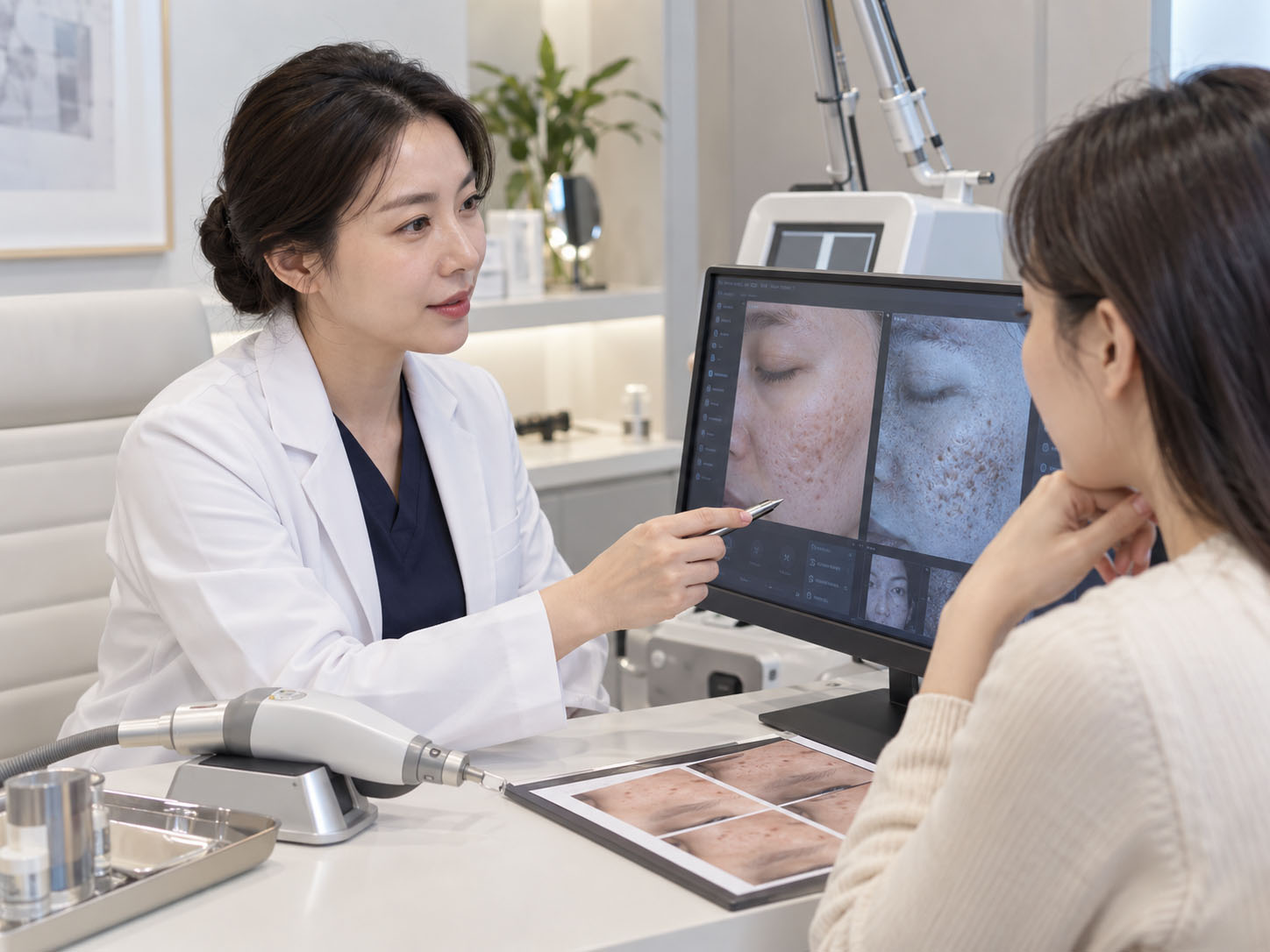
Acne scars vary in form and depth—ice-pick, boxcar, and rolling scars—and several types may be present on the same face. Even with the same fractional laser, recovery can differ depending on the wavelength, treatment depth, energy, and number of passes. In a consultation, therefore, it is more important to clarify which scars will be treated and to what depth than simply to ask whether the device is CO₂ or erbium.
Do not read efficacy differences beyond the scope of the studies
The 2026 meta-analysis found that fractional CO₂ was more likely than erbium-based fractional lasers to achieve at least 50% clinical improvement, but when randomized studies were analyzed separately, the statistical uncertainty increased.[1] Another 2026 analysis found that both CO₂ lasers and RF microneedling improved acne scars. CO₂ showed greater improvement, but also carried greater risks of pain, prolonged erythema, and post-inflammatory hyperpigmentation.[2]
A shorter downtime does not necessarily mean a weaker treatment
The recovery period is an important factor in treatment choice, depending on work schedules, travel, skin tone, and a history of hyperpigmentation. A recent randomized split-face study likewise found that both RF microneedling and CO₂ improved scars, while the RF side had less redness, pain, swelling, and prolonged crusting, as well as fewer hyperpigmentation events.[3] The treatment plan should account not only for efficacy but also for whether the recovery period is manageable.
Four points to confirm during a consultation
First, what type of scars do I have? Second, are the selected device and settings appropriate for those scars? Third, is there enough time between the expected redness, crusting, and hyperpigmentation and any important commitments? Fourth, is one procedure enough, or is combination treatment with subcision, another laser, or RF needed? Combination treatments showed better results in some studies, but the quality of evidence varies by combination, so they should not be judged by the package name alone.[2]
DERME VERDICT
Choosing an acne scar laser is not a matter of selecting the “strongest” device. The decision should consider scar type, skin tone, available recovery time, the risk of hyperpigmentation, and the need for combination treatment together. When comparing CO₂, erbium, and RF, look first not at a single efficacy figure but at the conditions of the studies and how closely they resemble your own skin.
- Source
- [1] Song X, Zhi BW · Comparative efficacy and safety of fractional carbon dioxide and erbium-based fractional lasers for atrophic acne scars (2026-09-10)
- [2] Ou Y et al. · Laser, Microneedling, and Combination Therapies for Moderate to Severe Acne Atrophic Scars (2026-07-10)
- [3] Comparative efficacy, recovery, and pigmentary safety of radiofrequency microneedling and fractional carbon dioxide laser (2026)