The answer is clear. There is no basis for considering needle-free hyaluron pens safer than injectable fillers, and ‘needle-free’ does not mean there is no risk of vascular or skin damage. Devices that force hyaluronic acid and other substances in under high pressure can be difficult to control precisely in terms of injection location and depth.
The U.S. Food and Drug Administration (FDA) says it has not authorized needle-free devices for cosmetic filler injections and advises that serious or permanent damage to the skin, lips, and eyes has been reported.[1] Health Canada has likewise warned that devices such as hyaluron pens, hyaluron guns, and fog injectors are not authorized and carry risks of infection and tissue damage.[2] The positions of these two regulators concern authorization status in their respective countries and do not substitute for checking authorization in Korea, but they are important warning signs when evaluating safety claims.
What does a hyaluron pen do?
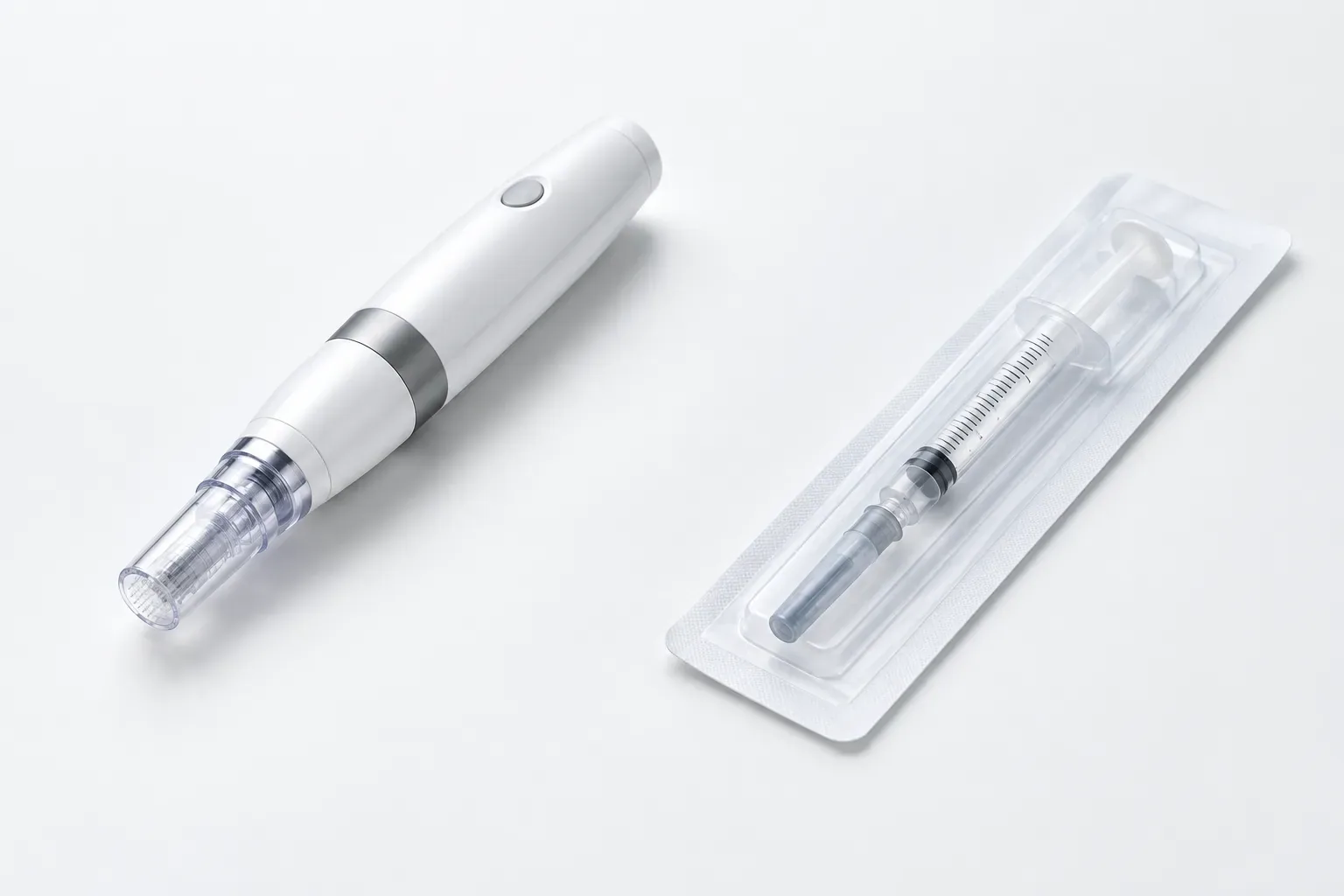
A hyaluron pen is a device that uses pressure to push a liquid or gel beyond the skin barrier and into tissue. Advertisements emphasize that it is ‘noninvasive’ or ‘painless,’ but once a substance passes through the skin and enters tissue, it carries risks different from those of a simple topical cosmetic. Even without a needle mark, the possibility of tissue damage and contamination remains.
The FDA explains that high-pressure devices cannot adequately control where the filler is placed.[1] In a warning letter made public in 2024, it also identified as a medical-device claim an advertisement by one company stating that its device could deliver hyaluronic acid into the dermis to enlarge lips and reduce wrinkles.[3] Terms such as ‘nano-injection’ are not clinical results demonstrating efficacy or safety.
Why can blood vessels and the eyes be at risk even without a needle?
There is no guarantee that material forced in under pressure will remain only in the intended layer. If it enters a blood vessel or compresses one from outside, vascular occlusion can occur, blocking blood flow. Even with conventional injectable fillers, vascular occlusion is the most serious complication and can lead to skin necrosis, stroke, or blindness.[1]
The risks of needle-free devices increase less because of the absence or presence of a needle than because of positional control and emergency response. If the product’s source is unclear or a device is shared by multiple people, the risks of bacterial or fungal infection and disease transmission are also added.[2] The decisive weakness of self-treatment is that, even when warning signs are recognized, there is no established system for immediate assessment and treatment.
What should be compared with an in-clinic injectable filler?
The first line of the comparison is not pain, but three checks: the product, the device, and the practitioner. With an in-clinic filler, confirm that an authorized finished product is used in a sealed condition and that it is injected with a needle or cannula by a medical professional trained in anatomy and complication management. A cannula does not eliminate the risk of vascular occlusion, but at minimum, you can ask about product traceability and the emergency treatment plan.
The second line is how reversible the outcome is. Depending on the circumstances, hyaluronic acid filler can be treated with an attempt to dissolve it using hyaluronidase, but this does not mean every injury can be reversed immediately. Different materials, such as calcium, PLLA, and PMMA, also have different removal methods and limitations. The fact that the ingredient name is ‘hyaluronic acid’ does not make the device and the finished product equally safe.
Which symptoms should be checked immediately after treatment?
Seek immediate medical evaluation if pain is progressively worsening, the skin turns pale and then develops a purple, net-like pattern, the area feels cold, or blisters appear. Blurred vision, double vision, eye pain, headache, or weakness in one arm or leg are emergency signs. Do not wait assuming it is merely a bruise; call 119 or go to an emergency department.
Swelling and bruising can last from several days to several weeks even with conventional fillers, but rapidly worsening pain and changes in skin color are different.[1] Record the product name, device name, treatment time, and treatment site, and bring a photo of the packaging if possible. Concealing the cause can delay treatment decisions.
What are the alternatives if you want more lip volume without needles?
For a short-term visual effect, adjusting the contour with the placement of lip liner and gloss carries the lowest risk. If you want longer-lasting volume, decide after confirming at a medical institution which products are authorized, how long the expected results will last, and what protocol is in place for vascular occlusion. Rather than focusing on the single word ‘needle-free,’ the safer choice is to ask what is being put into the tissue and how.
FAQ | Is hyaluronic acid safe because it is also found in the body?
Safety cannot be judged by familiarity with the ingredient alone. Manufacturing and sterilization, the cross-linking method, particle characteristics, the injection layer and amount, and the device’s control capabilities all affect the outcome.
FAQ | Is it okay to have it done at a beauty salon or home-care shop?
For procedures that put a substance into tissue, the essential factor is a medical system capable of diagnosing complications and treating them immediately. Rather than relying on advertising language, check the authorization status in Korea of the product and device, the practitioner’s license, and the emergency plan.
DERME VERDICT | Look at positional control and emergency systems, not ‘needle-free’ claims
Hyaluron pens may appear simple by playing on fear of needles, but the core risk lies not in the needle mark but in uncontrolled injection into tissue. Avoid purchasing them for self-treatment, and if you are considering the procedure, first check three things: the product label, the practitioner’s qualifications, and the response protocol for vascular occlusion.
Sources
[1] U.S. FDA · Dermal Filler Do's and Don'ts for Wrinkles, Lips and More · 2023-07-07
[2] Health Canada · Needle-free dermal filler devices are not authorized · 2019-09-13
[3] U.S. FDA · Ostar Beauty Sci-Tech Warning Letter · 2024-05-28