If swelling or a firm nodule develops weeks or months after hyaluronic acid filler, it should not immediately be labeled an “allergy.” Delayed inflammatory reactions can present similarly to immune-mediated inflammation, infection, or a foreign-body reaction, yet the treatment approach differs for each.[1][2]
A 2026 systematic review defined nodules, erythema, and edema appearing more than two weeks after treatment as delayed inflammatory reactions. Reported rates differed by product cross-linking technology, but differences in study design and follow-up periods mean the findings cannot be interpreted as evidence that one product is superior to another.[1]
When Is a Delayed Filler Inflammatory Reaction Considered “Delayed”?
This meta-analysis used more than two weeks as the threshold.[1] In clinical practice, however, timing alone does not establish a diagnosis. Whether both sides swelled on the same day, whether only one area is painful, whether there was a preceding event such as dental treatment, an infection, or vaccination, and which product was injected, into which layer, and in what amount are more important.
How Do Infection and an Immune Reaction Differ?
Infection may be suggested by one-sided signs such as pain, warmth, tenderness, or an abscess. An immune-mediated delayed reaction may involve swelling at multiple injection sites around the same time or appear after an infection. But appearance alone cannot confirm the cause. Culture, ultrasound, and treatment records should be considered together.
The FDA also lists delayed inflammation as a known adverse reaction to fillers and states that cases have been reported at injection sites after viral or bacterial illnesses or infections.[2] This does not mean that swelling after a cold is necessarily an immune reaction; it means that potential triggers should be assessed through the medical history.
What Can Ultrasound Show?
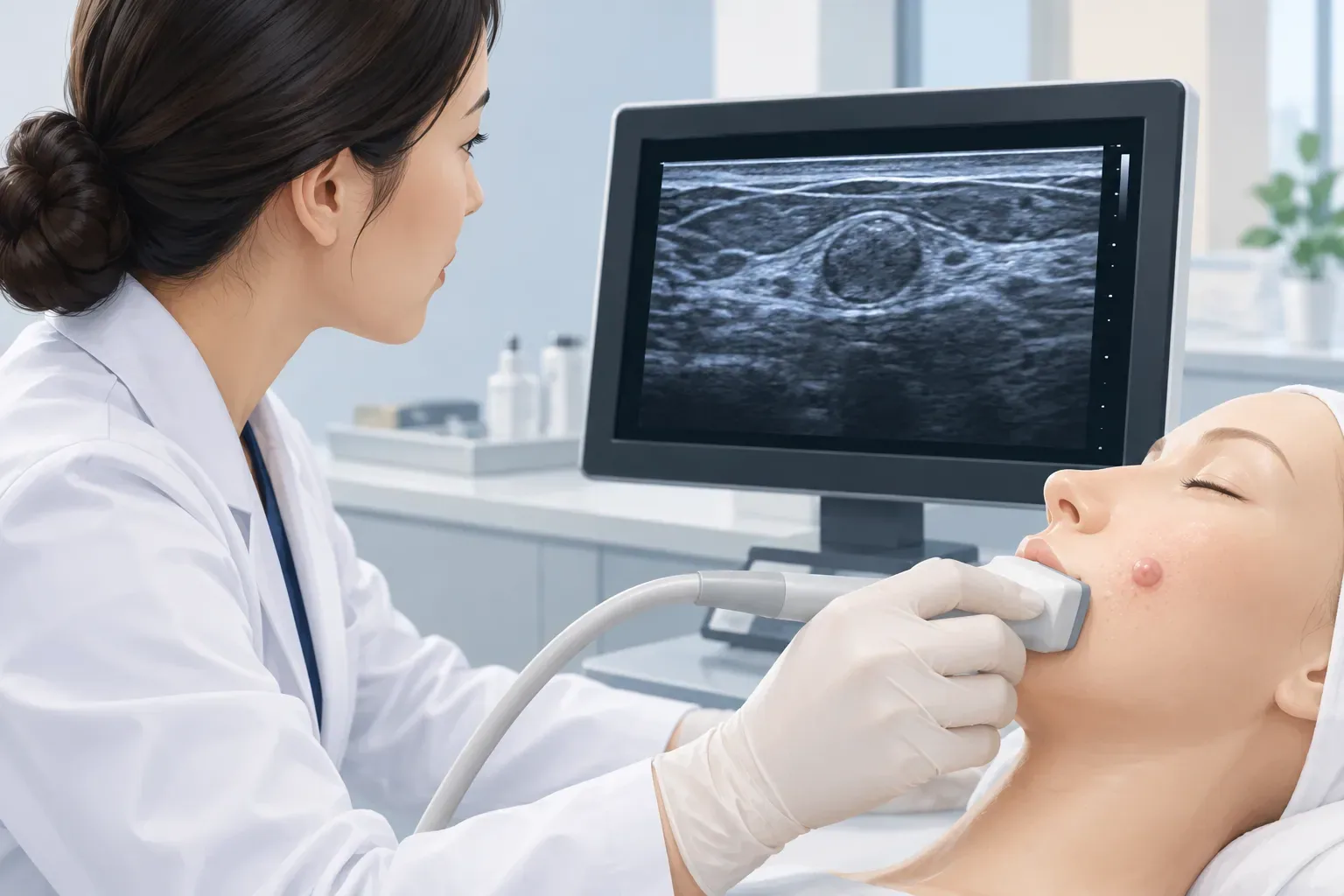
High-frequency ultrasound can help identify the layer containing the filler, spaces where fluid has collected, inflamed tissue, and increased blood flow. The mere presence of filler does not establish the cause, but ultrasound is useful for assessing the depth and extent of a lesion before inserting a needle and for determining where to drain or dissolve it.
What Should Be Compared Before Treatment?
First is the possibility of infection. If infection is suspected, starting with steroids may mask or worsen the symptoms. Second are the product type and location. Hyaluronic acid fillers can be broken down with hyaluronidase, but the same approach does not work for other materials. Third are signs of a vascular complication. If the skin becomes pale or mottled and severe pain or visual changes develop, this is not a situation in which to wait for a delayed reaction to resolve.
A 2025 review concluded that managing delayed complications may require different choices among antibiotics, hyaluronidase, and anti-inflammatory treatment depending on the cause.[3] Accordingly, an approach that omits the cause—such as “dissolve it all at once and be done” or “start with steroids”—is not a reasonable treatment framework.
FAQ
If there is swelling, should the filler be dissolved immediately?
No. Infection, the product type, and the lesion’s location should be assessed first. Hyaluronidase acts only on hyaluronic acid fillers and is not a standalone solution when the cause is different.
Can swelling also occur after dental treatment?
There have been reports.[2] This does not mean that dental treatment causes every delayed reaction. Record the treatment date and product name, the date of the dental treatment, and any systemic symptoms of infection, and share them with the clinician.
DERME VERDICT
The key questions with delayed swelling are not “Is it an allergy?” but “Has infection been ruled out first, and which filler is located in which layer?” Securing the treatment records, being evaluated at a medical facility that can perform ultrasound, and then determining the treatment sequence according to the cause is the safer approach.
- Source
- [1] Aesthetic Surgery Journal Open Forum·Incidence and Characteristics of Delayed Inflammatory Reactions Secondary to Hyaluronic Acid Filler Injections·2026-09-02
- [2] U.S. FDA·Dermal Fillers (Soft Tissue Fillers)·2023-07-06
- [3] PubMed·Management of Delayed Complications of Hyaluronic Acid Fillers·2025