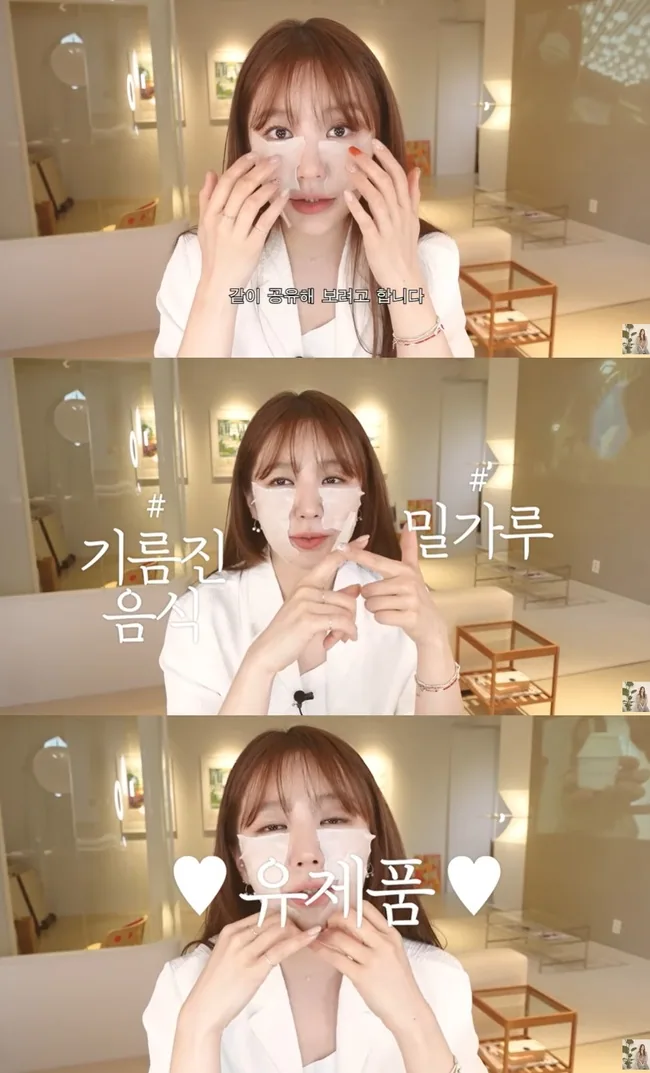
The key point: Dairy products and eating habits that rapidly raise blood sugar may be associated with acne in some people, but summer breakouts cannot be explained by a single food or resolved simply by cutting something out altogether. On July 21, 2026, Yoon Eun-hye said on her YouTube channel, “I get so many skin breakouts whenever summer comes around that it stresses me out,” and admitted that although people tell her to stop eating flour and dairy products, it is not easy for her to do so.[1][2]

Why do breakouts get worse every summer?
In summer, high temperatures and humidity, sweat, sebum, sunscreen, makeup and friction can all converge. In this environment, pores clog more easily and the skin is more prone to irritation. Elements that repeatedly touch the skin—such as masks, hats, bangs and mobile phones—can also aggravate breakouts.
Will acne improve if you stop eating flour and dairy products?
There is no single answer for everyone. Some studies have reported an association between milk consumption and acne, as well as between a high-glycemic-load diet and acne. However, most of these studies are observational, or involve different participants and dietary habits, so it is not possible to conclude that “everyone improves when they stop eating dairy” or that “flour is a direct cause of acne.”[3][4]
In practice, factors such as lack of sleep, stress, the menstrual cycle, cosmetic irritation, frequent touching and increased sebum production in summer often act simultaneously. Rather than banning a particular food outright, it is more practical to record what you eat and how your skin changes over two to four weeks to identify recurring patterns.
First, distinguish between acne and folliculitis
Not every summer “pimple” is acne. If blackheads, whiteheads and red inflammatory lesions are mixed together, acne is more likely. But if small, similar-sized lesions spread with itching or suddenly worsen after sweating, other conditions, including folliculitis, should be considered. Using the same treatment simply because the lesions look similar can actually make the condition worse.
What to change first in daily life when summer breakouts worsen
1. Do not over-wash your face
When breakouts appear, you may feel like washing your face repeatedly, but frequent use of strong cleansers can further irritate the skin barrier. Maintain basic cleansing in the morning and evening, and after heavy sweating, rinse with lukewarm water and use a mild cleanser.
2. Simplify your skincare routine
When summer breakouts are severe, do not increase several exfoliating acids, scrubs, retinol and high-concentration active ingredients at the same time. Simplifying your routine to a cleanser, moisturizer, sunscreen and any necessary acne medication makes it easier to identify sources of irritation.
3. Record your diet rather than banning foods
Record whether skin worsening repeatedly follows specific foods such as milk, ice cream, bread, instant noodles or late-night meals. It is important not to assume that a food is the cause simply because a breakout appeared after eating it once, but to look for recurring patterns.
In what order is acne treated in dermatology?
The American Academy of Dermatology (AAD) acne guidelines recommend benzoyl peroxide, topical retinoids and topical antibiotics among the main treatment options.[5] If red, painful inflammatory lesions recur, the priority is to stabilize the acne itself. Large nodular lesions carry a risk of scarring, so when necessary, rapid methods of controlling inflammation, such as intralesional corticosteroid injections, may be considered.[5]
If clogged pores, excess sebum or uneven skin texture remain after active inflammation has stabilized, pore- and texture-focused procedures can then be evaluated separately. Seolleim Clinic currently offers programs targeting pores, sebum and skin texture, including the Silky Pore Injection.[6] However, a clinic’s menu establishes that the service is offered; it does not substitute for independent evidence of efficacy or safety.
Frequently asked questions
Do I need to cut out dairy completely?
Not necessarily. There may be an association for some people, but dairy does not affect everyone in the same way. It is better to adjust your diet after checking whether a particular food is repeatedly followed by worsening symptoms.[3]
Is it better not to wear sunscreen in summer?
No. Ultraviolet exposure can make acne marks and hyperpigmentation last longer. If you are concerned about shine, it is better to choose a lightweight, non-comedogenic formula.
Can I use moisturizer if I have acne?
Yes, it may be necessary. However, it is better to choose a product that helps maintain the skin barrier while having a lower likelihood of clogging pores, rather than one with an excessively heavy or occlusive texture.
Dr. Kang Jeong-ha’s recommendations
For summer breakouts, it is more realistic to manage daily irritants and the sebum environment together rather than simply cutting out one food. First, reduce excessive cleansing and the simultaneous use of multiple active ingredients, and simplify your basic routine. Second, for red, painful inflammatory acne, begin with evidence-based treatments such as benzoyl peroxide and retinoids; for large inflammatory lesions, consider rapid methods of controlling inflammation, such as intralesional injections, when necessary.[5] Third, if concerns about pores, sebum or skin texture remain after active acne has stabilized, consider pore-focused procedures such as the Silky Pore Injection separately at that point.[6] Dietary adjustments are a supportive strategy; treating active inflammation comes first.
Sources
[1] Yoon Eun-hye’s EUNHYELOGIN · Yoon Eun-hye’s July Daily Items! · 2026-07-21
[3] Journal of the American Academy of Dermatology · Dairy intake and acne development meta-analysis
[5] American Academy of Dermatology · Updated guidelines for the management of acne · 2024-01-31
[6] Seolleim Clinic · Silky Pore Injection

Interesting Dermatology Stories for Healthy Skin
Drawing on 16 years of experience running Seolleim Clinic in Gangnam, I explain practical skincare methods and engaging stories about dermatology, using celebrities, public figures and television as subjects, in an easy and approachable way. Through professional knowledge and experience, I hope to help your skin look healthier and more radiant. I hope this series broadens your understanding of skin and helps you discover ways to care for yourself.
Kang Jeong-ha, Medical Director (Seolleim Clinic Gangnam)
- Source
- [1] 윤은혜의 EUNHYELOGIN·윤은혜의 7월 데일리템!·2026-07-21
- [2] OSEN·13년간 흰쌀밥·탄산음료 끊은 것 아냐 윤은혜 방송 이후 불거진 오해 적극 해명·2026-07-21
- [3] Journal of the American Academy of Dermatology·Dairy intake and acne development meta-analysis
- [4] American Journal of Clinical Nutrition·Low-glycemic-load diet and acne randomized controlled trial
- [5] American Academy of Dermatology·Updated guidelines for the management of acne·2024-01-31
- [6] 설레임의원·실키모공주사