Ultherapy 600 lines are not automatically twice as powerful or twice as long-lasting as 300 lines. The number of lines generally indicates how many ultrasound treatment lines have been placed over a given area, while the actual results and safety are determined together by depth, energy, spacing, and anatomical location. [1][2]
A larger number may seem easier to compare, making it the focus of a price quote, but it cannot by itself reveal the treatment plan. Even with the same 300 lines, the density in one area will differ depending on whether they are concentrated on the lower face or distributed more broadly across the face and neck. The first question, therefore, should be ‘Where and why are they being placed?’ rather than simply ‘How many lines?’
What exactly does the number of Ultherapy lines mean?
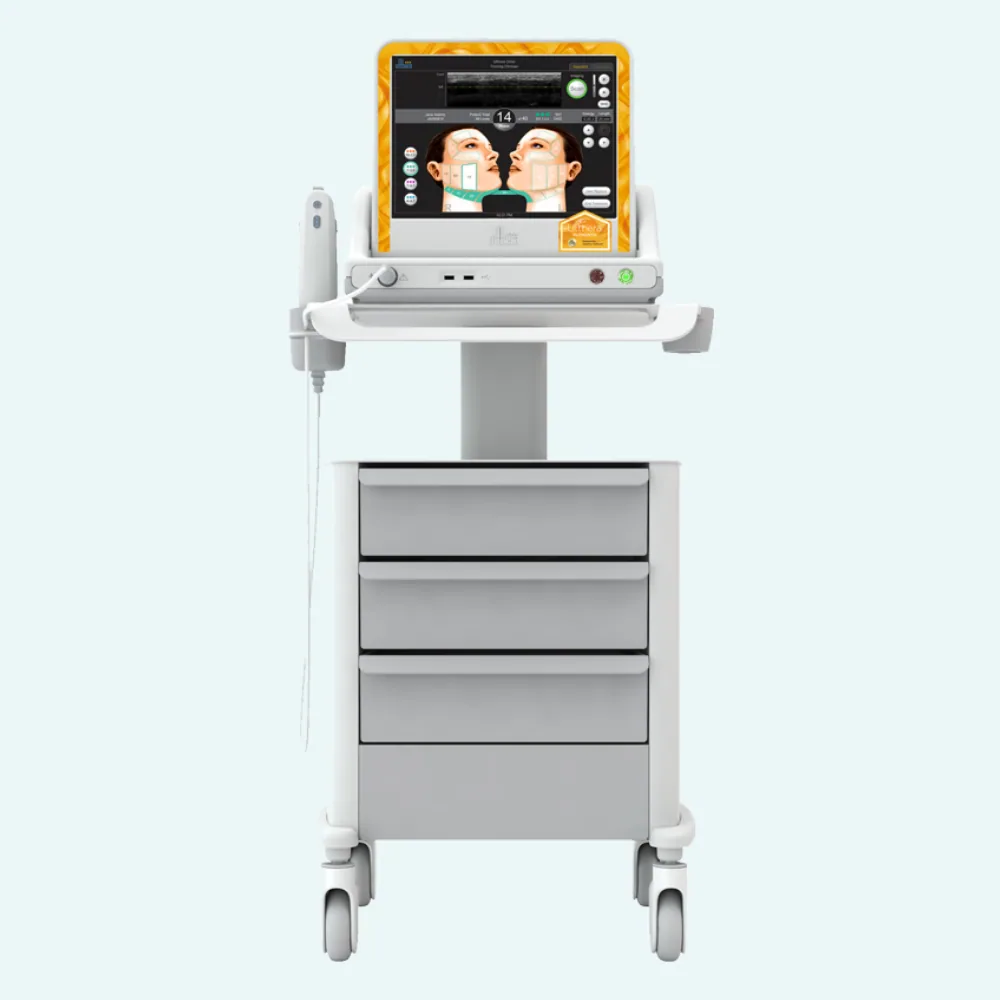
Ultherapy combines microfocused ultrasound with imaging. MFU-V (Microfocused Ultrasound with Visualization) refers to creating small thermal coagulation points in a line while viewing the target layer beneath the skin through imaging. One cartridge firing is recorded as a single treatment line containing multiple coagulation points, and the ‘shots’ consumers refer to usually mean the number of these treatment lines.
The number of lines is one element of the treatment area and plan, not an independent standardized dose like the dosage of a medication. A 2026 clinical commentary also explains that in energy-based aesthetic procedures, ‘more energy’ does not reliably guarantee better results; the goal is to create a sufficient thermal dose suited to the tissue and device within a safe range. [1]
How do 300 and 600 lines usually differ?
Three hundred lines may be considered when treatment is concentrated on a limited area, the face is smaller, or laxity is limited. Six hundred lines may be proposed for broader areas, such as the face, jawline, and neck, or when cartridges at multiple depths are combined. This is not an absolute rule, however. Seolleim Clinic’s official guidance also states that the number of lines varies according to face size, degree of laxity, and treatment area. This guidance confirms the clinic’s operating approach; it is not an independent clinical trial proving efficacy. [4]
The important question here is not ‘Are 600 lines enough?’ The key is ① which areas are treated, ② at how many depths, ③ with what spacing, and ④ how the treatment is divided while taking nerves and bones that should be avoided into account. Six hundred lines across the entire face and 600 lines on the lower face may have different treatment densities even if they carry the same product name.
Four things to compare before the number of lines
1. Treatment goal: Skin laxity, fat, or lack of volume?
Microfocused ultrasound aims for tissue contraction and collagen remodeling, but it is not a procedure that directly restores volume. Increasing the number of lines on a face that appears lax because of hollow cheeks or skeletal structure may produce a contour contrary to the desired result. Submental fat, skin laxity, and volume loss should first be distinguished.
2. Depth and treatment-line placement
Repeatedly treating a broad area at one depth is different from combining multiple depths according to the anatomy. Real-time imaging is used to confirm the target layer and contact. International consensus materials explain that visualization, patient selection, and appropriate contact are important for safe treatment. [3]
3. Device and approved indications
Even when devices share the name ‘HIFU,’ they do not all have identical performance, clinical data, or approved indications. The U.S. FDA classifies focused ultrasound stimulator systems for aesthetic use as Class II medical devices, which require special controls, and directs users to check each product’s 510(k) documentation and labeled intended use. Data from one device should not be directly applied to another. [2]
4. The practitioner’s anatomical planning and pain management
Bone prominence, nerve pathways, and the thickness of subcutaneous fat vary from person to person. Severe pain does not automatically mean greater efficacy, and making a patient endure intense pain is no substitute for careful planning. If you experience an electric-shock-like pain or abnormal sensations during treatment, report them immediately so placement can be reassessed.
When do results appear, and how long do they last?
Some people may feel tightening immediately after treatment, but the final assessment should take into account tissue responses over several weeks to months. Systematic reviews report improvement in laxity of the face and neck, but devices, assessment methods, treatment areas, and follow-up periods vary among studies, so an effect of the same magnitude cannot be promised for every individual. There is also no formula for calculating duration from the number of lines alone. [3]
Do recovery and side effects increase with the number of lines?
Redness, swelling, tenderness, and temporary sensory changes are relatively common and generally limited. Serious problems such as burns, blisters, skin depressions, and nerve-related symptoms have been reported rarely. A 2026 review of complication management identifies inappropriate spacing, air pockets, and anatomical misjudgment as preventable factors. This means that energy, overlap, and contact conditions matter alongside the number of lines. [5]
Six hundred lines are not automatically dangerous, nor are 300 lines automatically safe. However, risk may increase if many treatment lines are excessively overlapped in the same small area or if a thin face is exposed to a high thermal burden. This is why patients should receive a documented explanation of pre-treatment photographs and palpation, imaging confirmation, and area-specific planning.
What should you check in a price quote?
Rather than comparing only the total price, ask for separate details on the exact device model, how genuine tips are verified, included areas, cartridge depths, line distribution, anesthesia and medication costs, and aftercare fees. Even the term ‘full face’ may or may not include the neck, submental area, or forehead. Ask whether lower-priced additional lines are actually needed for the target area, and whether they can be reduced if they are not.
Frequently asked questions
Q. If I have a small face, are 300 lines enough?
Face size alone cannot determine this. The location and degree of laxity, subcutaneous fat, whether the neck is included, and the depths to be used should all be considered. A small face may require more treatment lines if several areas are treated, while a larger face may be planned with fewer lines if the target is limited.
Q. Are two 300-line treatments equivalent to one 600-line treatment?
They cannot be considered equivalent. The treatment interval and the distribution of areas and depths differ, as do tissue responses. Repeating treatment by simply adding up the numbers without adequately observing the response to the first treatment may result in unnecessary treatment.
Q. Can I choose radiofrequency lifting instead of Ultherapy?
It is possible, but the goals differ. The method and depth by which radiofrequency devices deliver heat to the skin and subcutaneous tissue vary by product. They should be compared based on skin thickness, fat volume, location of laxity, pain tolerance, and recovery schedule; changing only the brand name should not lead you to expect the same results.
DERME VERDICT | Numbers do not replace a treatment plan
The criterion for choosing between 300 and 600 lines is not ‘more,’ but ‘enough for the necessary layers and areas.’ Before asking about the number of lines during a consultation, confirm the treatment goals and areas to be excluded, and receive an explanation of the area-by-area distribution and depths, device model, key risks, and alternatives as a single treatment plan. A good quote is not a document that promises a large number; it is a document that shows why that number is appropriate.
- Source
- [1] Journal of Cosmetic Dermatology · Is More Energy Reliably Better in Energy-Based Aesthetic Practice? · 2026-07-31
- [2] U.S. FDA · Focused Ultrasound Stimulator System for Aesthetic Use · 2018-03-23
- [3] PubMed · Consensus on Safety and Review of Energy-Based Devices / MFU-V · 2022
- [4] Seolleim Clinic · Official Ultherapy guidance
- [5] Journal of Cosmetic Dermatology · Evidence-Based Management Recommendations for MFU-V-Related Complications · 2026
- [4] 설레임의원 · 울쎄라 공식 안내