Exosomes are not the name of a single “regenerative ingredient.” They are tiny vesicles released by cells, and the proteins and genetic material they contain vary depending on which cells they are obtained from and how they are purified. Early human studies have reported improvements in skin texture, hydration and pigmentation markers, but the evidence currently available does not support treating all exosome products and all delivery methods as equally effective.[2][3]
The first distinction consumers should make is whether the treatment involves injections or application after microneedling or laser treatment. The depth of penetration, amount of exposure and risk of infection differ. Rather than focusing on the “exosome content” numbers used in advertising, it is more useful for assessing safety and effectiveness to check the actual finished product and its delivery route.
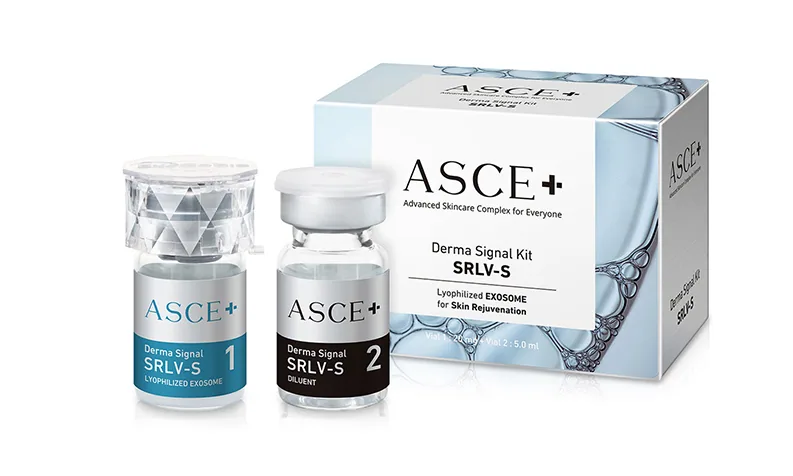
What exactly is an exosome skin booster?
Exosomes are one type of extracellular vesicle. Extracellular vesicles are membrane-bound sacs released by cells to exchange signals with other cells. The problem is that in the aesthetics market, the term “exosome” can broadly refer to everything from purified vesicles to cell culture media and materials containing a mixture of various growth factors.
A product’s name alone therefore cannot reveal its composition or quality. It is necessary to check which cells the material originated from—human, plant or microbial—how the particle count and protein content were measured, and whether sterility and endotoxin testing were performed. Endotoxins are components of the outer membranes of bacteria and can trigger a strong inflammatory response when they enter the body.
What effects have been observed in human studies?
A 2026 systematic review and meta-analysis in the Aesthetic Surgery Journal gathered clinical studies of exosomes and extracellular vesicles used for skin rejuvenation and reported signals of improvement related to skin texture, hydration, pigmentation and wrinkles. However, the source materials, concentrations, treatment combinations and assessment times varied between studies, making it difficult to translate the findings into the effect of a single standard treatment.[2]
A 2026 systematic review of human studies in Cureus likewise concluded that short-term results were promising, but that sample sizes were small, follow-up periods were short and manufacturing standards were lacking.[3] This limitation matters. When studies use microneedling together with exosomes, it is difficult to separate the improved results from the effects of exosomes alone.
How do injections differ from application after laser or microneedling?
Injections place the material directly into the dermis or subcutaneous tissue. Sterility, impurities, particle size and management of immune responses are therefore especially important. Topical application is more likely to remain on the surface, but the amount that enters the skin may differ when it is applied immediately after laser or microneedling has created channels.
A scoping review of topical exosome studies published in 2026 concluded that delivery devices and formulations varied, making it difficult to determine which combinations are most effective.[4] Neither the statement that “topical application is always gentler” nor the claim that “injections are more reliable” is supported by evidence. Even with the same source material, a change in delivery route requires separate evidence on effectiveness and safety.
How should advertising claims of FDA approval be read?
In a 2019 safety alert, the U.S. Food and Drug Administration (FDA) stated that there were no FDA-approved exosome products in the United States.[1] This describes the regulatory situation in the United States and does not substitute for information about the approval status of individual products in Korea. However, if you see the phrase “U.S. FDA-approved exosome,” check the product name, approval number and approved use in official documentation.
The fact that a product is used with an approved device also does not automatically establish the efficacy of the finished exosome product. Even if a microneedling device is approved, that does not necessarily mean that the material applied with it is approved for injection or delivery into the skin. During a consultation, ask for the device and product to be listed separately.
What should be considered when assessing side effects and recovery time?
Microneedling and laser treatment themselves can cause redness, swelling, stinging, crusting and post-inflammatory hyperpigmentation. Injections add the risks of bruising, pain, infection and immune reactions. The long-term risks of exosome materials have not been sufficiently studied, so it cannot be stated definitively that they cause “almost no side effects.”[2][3]
Recovery time depends less on the name exosome than on the depth and energy of the accompanying treatment and the condition of the skin. If you have an important event coming up, check in advance not only the expected duration of redness but also which clinic to contact and how to seek care if blisters, pus or increasing pain develops.
What four points must be compared during a consultation?
First, write down the exact name and manufacturer of the finished product. Second, check the source of the cells used for the material and the data on purification and sterility testing. Third, distinguish the actual delivery method: injection, topical application or use as an adjunct to microneedling. Fourth, ask whether human studies have been conducted using that finished product and delivery method. Testing of the source material or cell experiments is not equivalent to clinical evidence for the finished product.
Also compare established treatments. If dryness is the main concern, a proven moisturizer or hyaluronic acid formulation may be the first option. For acne scars, laser treatment, subcision or radiofrequency microneedling tailored to the type of scar is central to treatment, while exosomes are closer to an adjunctive option.
Frequently asked questions
Is an exosome treatment the same as stem cell therapy?
No. Exosomes are not living cells but vesicles released by cells. However, their contents vary according to the source cells and manufacturing process, so the fact that they are “not cells” does not eliminate the risks.
Will my skin regenerate after just one treatment?
“Regeneration” is a vague advertising term. Studies have mainly measured indicators such as hydration, elasticity, wrinkles and pigmentation, and the observation periods have also been short.[2][3] A single treatment should not be interpreted as fundamentally reversing scar structure or aging.
DERME VERDICT
The biggest mistake when choosing an exosome treatment is mistaking a single name for product quality. Comparison is possible only when the source of the material, manufacturing and purification, delivery route and human evidence for the finished product have all been verified. If these four points cannot be explained with documentation, choosing an established treatment with clearer evidence first is the more reasonable option.
- Source
- [1]U.S. Food and Drug Administration·Public Safety Alert Due to Marketing of Unapproved Stem Cell and Exosome Products·2019-12-06
- [2]Aesthetic Surgery Journal·Exosome Therapy for Skin Rejuvenation: A Systematic Review and Meta-Analysis of Human Studies·2026-04-01
- [3]Cureus/PubMed·Exosomes for Human Skin Rejuvenation: A Systematic Review of Clinical Evidence·2026-02-24
- [4]Aesthetic Surgery Journal·Topical Exosome Therapy for Facial Rejuvenation: A Scoping Review·2026-07-07