The short answer: laser hair removal is possible even for darker skin. However, because the skin’s melanin can also absorb light in a treatment designed to selectively heat the melanin in the hair, the wavelength and energy settings matched to skin tone and hair thickness matter more than the device name alone.[1][2]
The key point: for darker skin, consider a longer wavelength such as the 1064 nm Nd:YAG first, while also checking the practitioner’s experience, the cooling system, and whether a test spot is performed.
How does laser hair removal reduce hair?
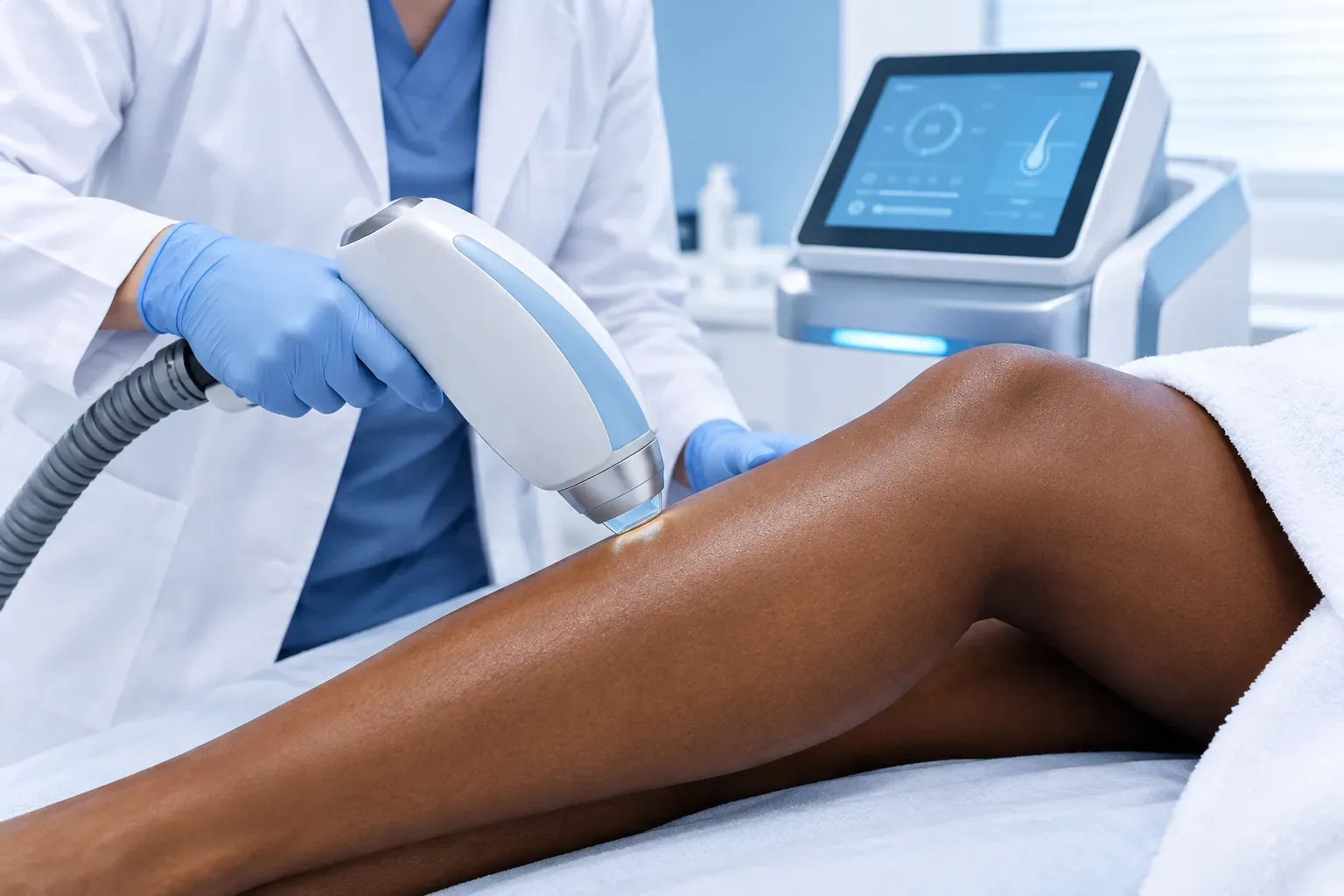
Laser hair removal uses the principle of selective photothermolysis. The hair’s dark pigment, melanin, absorbs light at a specific wavelength and converts it into heat, weakening the growth area of the follicle while minimizing damage to the surrounding skin.
In FDA documents, “permanent hair reduction” refers to a long-term, stable reduction in the number of hairs that regrow when measured at 6, 9, and 12 months after treatment has ended.[3] It does not mean that all hair is permanently removed in a single session.
Why is wavelength selection more important for darker skin?
The more melanin there is at the skin’s surface, the more likely it is that laser energy will be absorbed by the skin before reaching the follicle. If the settings are unsuitable, the risk of burns, blisters, scabs, and post-inflammatory hyperpigmentation or hypopigmentation may increase.[2]
Longer wavelengths are absorbed relatively less by melanin at the skin’s surface and reach deeper. In a systematic review of skin types III to VI, long-pulsed Nd:YAG showed a lower tendency toward post-inflammatory hyperpigmentation than IPL. However, the number of comparative studies and the treatment conditions were limited, so the findings cannot be applied identically to every device.[1]
What is the difference between Nd:YAG, diode, and Alexandrite lasers?
The 1064 nm Nd:YAG is often selected for darker skin because of its longer wavelength. Diode lasers at 800–810 nm fall in between, while the 755 nm Alexandrite laser is effective for the combination of lighter skin and dark hair but requires more careful settings for darker skin.[2][4]
Even at the same wavelength, results vary according to pulse duration, spot size, skin cooling, and fluence. Rather than asking whether “this device is safe,” it is more useful to ask whether the medical professional has extensive experience treating that skin tone and whether they perform a test spot.
What level of effectiveness and recovery should you expect?
Because hairs grow on different cycles, multiple sessions are needed. Thick, dark hair tends to respond more readily, while white, gray, and very light hair have less target melanin and may respond less effectively. Areas such as the face, where hormones have a greater influence, may require maintenance treatments.
Redness or slight swelling around the follicles is common immediately after treatment. It usually settles quickly, but if pain worsens or blisters, grayish discoloration, or extensive scabbing develops, contact the treatment provider rather than waiting.
How should you prepare before and after treatment?
Before treatment, avoid tanning and intense sun exposure, and stop methods that remove the roots, such as waxing and tweezing. Shaving generally is allowed because it leaves the follicle intact, but follow the clinic’s instructions on timing. Also report any medications you take, a history of keloids, and recent dermatitis or pigmentation problems.[4]
After treatment, temporarily limit activities that increase heat and friction, such as hot baths, saunas, and strenuous exercise, and use sun protection on exposed areas. Do not rub the skin or pick at scabs.
Laser Hair Removal FAQ
If my skin is dark, do I have to receive Nd:YAG treatment?
Not necessarily. Nd:YAG is a common first choice, but other options, including diode lasers, may also be suitable depending on skin tone, hair thickness and color, treatment area, and the device’s cooling method. The key is to tailor the parameters to the individual.
Is IPL the same as laser hair removal?
No. IPL uses intense pulsed light containing multiple wavelengths, while lasers emit a relatively specific wavelength. Both are used for hair reduction, but for darker skin, the risk of skin damage associated with energy distribution and settings must be considered.
At dermatology clinics in Seoul and Gangnam, what should you ask about before asking about cost?
First ask about the device’s wavelength, the clinic’s experience treating your skin tone, whether it performs test spots, its cooling method, the expected number of sessions, and its system for handling side effects. It is difficult to compare the total sessions required and safety management based only on a low per-session price.
DERME VERDICT
Laser hair removal for darker skin is not contraindicated. Assess skin and hair color together, and combine a longer wavelength with sufficient cooling, conservative settings, and testing on a small area to reduce risk. The right device and an experienced practitioner are more important selection criteria than “maximum power.”
Sources
[3] U.S. FDA · 510(k) K240983 Indications for Use · 2024-05-22
[4] American Academy of Dermatology · Laser hair removal: Preparation · Accessed 2026-10-12
- Source
- [1] Lasers in Medical Science·Lasers for reduction of unwanted hair in skin of colour: a systematic review and meta-analysis·2019-10-01
- [2] Journal of the American Academy of Dermatology·Laser and energy-based device use in skin of color: a clinical review·2026-09-01
- [3] 미국 FDA·510(k) K240983 Indications for Use·2024-05-22
- [4] 미국피부과학회·Laser hair removal: Preparation·확인일 2026-10-12