This is an AI draft for editorial review. Do not publish before fact-checking, reviewing the language and images, and completing any necessary medical review.
The key point is this: the success of a jawline-length flippy bob depends less on whether the face is round or long than on where the ends stop at the jaw and how far they move outward. When the ends align with the widest point of the jaw, they emphasize width; moving them 1–2 cm above or below changes the overall impression.
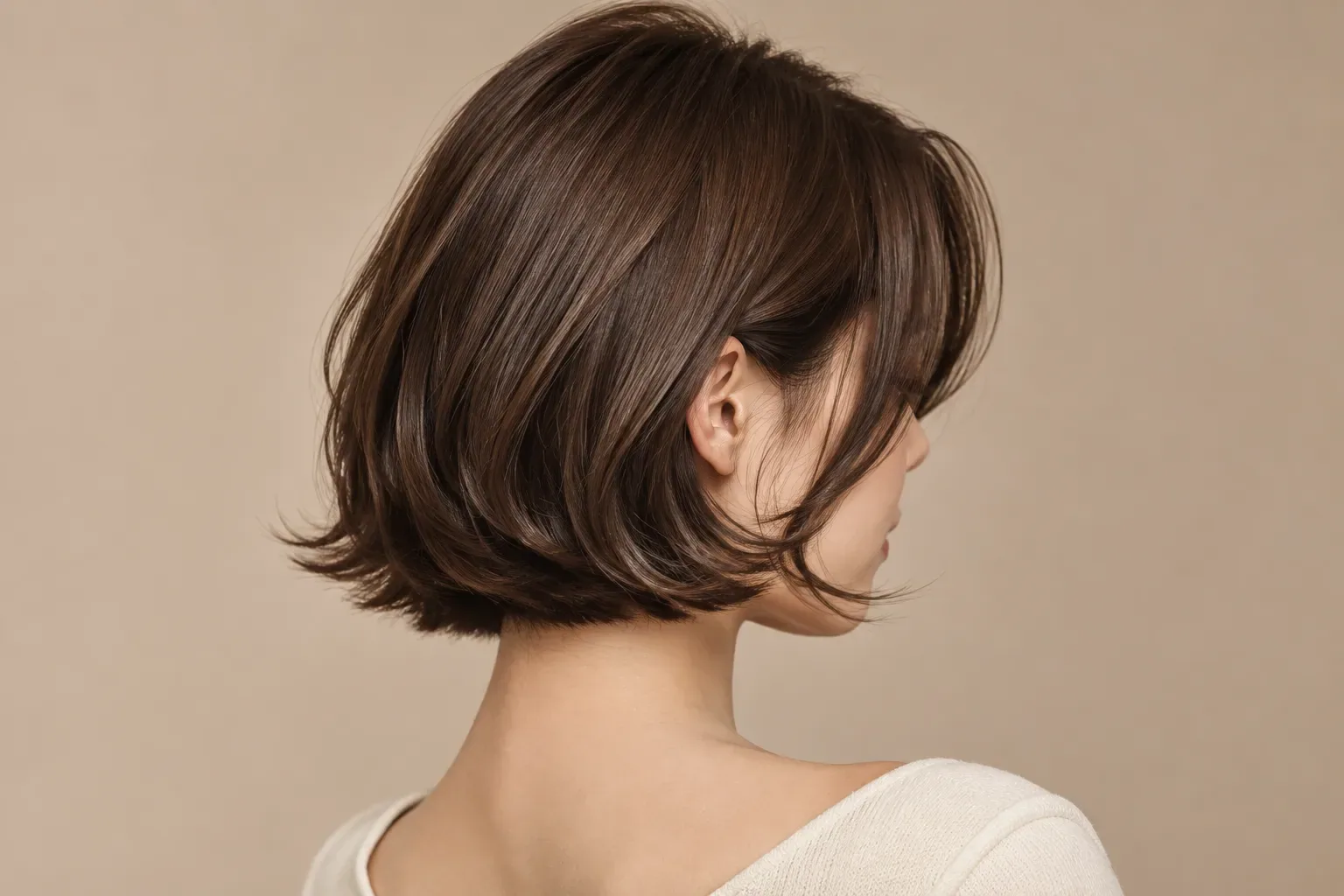
Vogue reported on October 23, 2026, that Ariana Grande had revealed a jaw-grazing one-length bob in place of the high ponytail she had worn for years. The key elements were a deep side part, chocolate-brown color, and ends flipped outward.[1] The novelty of the look lies less in the fact that it is shorter than in how it preserves a familiar romantic image by changing only the length and direction.
Who suits a jawline bob?
The first criterion is not the name of the face shape but the width of the jawline and the neckline. When the ends meet the widest part of the jaw exactly, they create a horizontal line that defines the lower face. If that is the desired effect, start by trying the length at the tip of the chin; to distribute it more softly, try a length 1–2 cm below the chin.
The second criterion is hair density. With fine hair, too many layers can make the ends look sparse, so the substantial outline of a one-length cut is advantageous. Conversely, if the hair is thick or coarse, failing to control the volume behind the ears and inside the nape can make the outward curl spread into a triangle. When showing reference photos, ask to see not only the front but also the volume at the sides and back.
How does a flippy bob differ from an inward C-curl?
An inward C-curl wraps around the jaw, gathering the outline into one shape. A flippy bob sends the ends outward, creating small areas of space around the neckline and ears. Even at the same jawline length, the former has a polished impression, while the latter feels lighter and more animated as it moves when you walk.
A personal selection criterion is the amount of time available for morning styling. If you plan to finish with air-drying alone, the cut line should work with the point where your hair naturally turns outward. If you can use hot tools every day, you can choose a design that changes the direction only at the final 3–4 cm. The direction in which your hair dries is more useful consultation material than a single photograph.
How can you create an outward curl in 10 minutes at home?
Dry the hair completely, then apply a thin layer of heat protectant. Lift the roots at the top, and use a brush or iron to turn only the ends outward by less than half a rotation. Rather than creating a sharp angle all at once, pass through each of four sections on the left and right once in the same direction for a cleaner line at the ends.
The American Academy of Dermatology says that excessive heat can damage hair and recommends reducing the use of blow-dryers and irons and using low or medium heat.[2] Laboratory research also found that surface damage increased at higher temperatures, while drying with a hair dryer held about 15 cm away and kept moving caused less damage than holding it close and stationary at high heat.[3] These figures are not prescriptions that apply unchanged to every device and hair type, but they are reason to abandon the idea that “hotter and longer” makes for better styling.
What should you try before getting a flippy bob?
Fold the hair up to jawline height and secure it with pins, then photograph the front, 45-degree angle, and side view. Compare the ends at the tip of the chin, 1 cm below the chin, and 2 cm below the chin to see which position makes the neck look longer and the lower face feel more balanced. Try switching the side part as well. Facial asymmetry is not a flaw; it is practical data for choosing the direction of the part.
FAQ | Can people with curly hair wear a flippy bob?
Yes, but rather than copying a “sleek, straight bob” exactly, the cut should account for the curl’s shrinkage and the direction of the ends. Consult based on the hair’s actual length when dry, not when wet, and if the design needs to be straightened every day to maintain it, factor the styling burden into the cost as well.
FAQ | If the ends keep flipping out, is the bob a failure?
Not necessarily. A flippy bob turns that tendency into intentional movement. However, if one side flips out excessively or the nape lifts away, the cut line and the direction of the hair’s movement need to be adjusted.
DERME VERDICT | Choose the “ends and time,” not the face shape
What to take from Ariana Grande’s change is not an exact copy of the length, but the way it changes one element of the silhouette while preserving a familiar image. Test the jawline position first, observe the direction in which your hair naturally dries, and determine how much time you can realistically spend on heat styling. That is how a bob can outlast the trend.
Sources
[1] Vogue · Ariana Grande Is Now Bobiana Grande · 2026-10-23
[2] American Academy of Dermatology · Tips for healthy hair · 2024-08-12
[3] Annals of Dermatology · Hair Shaft Damage from Heat and Drying Time of Hair Dryer · 2011-12-27