Two percent is not a score for being “more powerful.” The number the European Union’s Scientific Committee on Consumer Safety (SCCS) gave for tea tree oil is a safety assessment under specified product types and conditions of use. It is not a ranking of acne-treatment efficacy.
The key point: rather than comparing ingredient percentages alone, first check whether the product is rinsed off or left on the skin, and whether the finished product has been tested in humans. Even with the same tea tree oil, a 2% shampoo and a 0.1% face cream differ in the area of application and duration of exposure.
How far did the SCCS consider tea tree oil safe?
In its final opinion, the SCCS assessed tea tree oil as safe when used at up to 2.0% in shampoo, 1.0% in shower gel, 1.0% in cleanser, and 0.1% in face cream.[1] The preliminary opinion was adopted on May 28, 2025, and the final opinion on October 30, 2025; the European Union page was updated in June 2026.
This table is not a single limit applicable to all cosmetics. It must be read within the four product types assessed by the SCCS, the stated compositions, and the exposure scenarios. Applying these figures to forms outside the list, such as toners, ampoules, and spot oils, falls outside the scope of the assessment.
Why is the limit 2% for shampoo but 0.1% for face cream?
Looking only at concentration, shampoo is twenty times higher. But shampoo and cleanser are rinsed off, while face cream remains on the skin. The area of application, frequency of use, and contact time also differ between the scalp and face. Safety assessments calculate these exposure levels together.
That is why using the phrase “2% permitted” as an advertisement for the strength of a facial product reverses the context. Regulatory figures reflect not the ingredient’s performance alone, but also how and how often the product is used.
How strong is the evidence for tea tree oil against acne?
There have been small studies involving mild acne. A 2007 randomized, double-blind trial had 60 participants use either 5% tea tree oil gel or a placebo for 45 days, and reported greater improvements in lesion counts and severity measures in the tea tree oil group.[2] In a 1990 single-blind trial of 124 participants, 5% tea tree gel reduced lesions, although its action was slower than that of 5% benzoyl peroxide.[3]
However, these findings cannot be extended to every tea tree cosmetic currently on the market. The studies tested specific concentrations and formulations, and had small or dated samples. Even when the ingredient is the same, differences in the way it is solubilized, the preservatives, the container, and the amount delivered to the skin can change the efficacy and irritation profile of the finished product.
Why can it cause irritation even though it is “natural”?
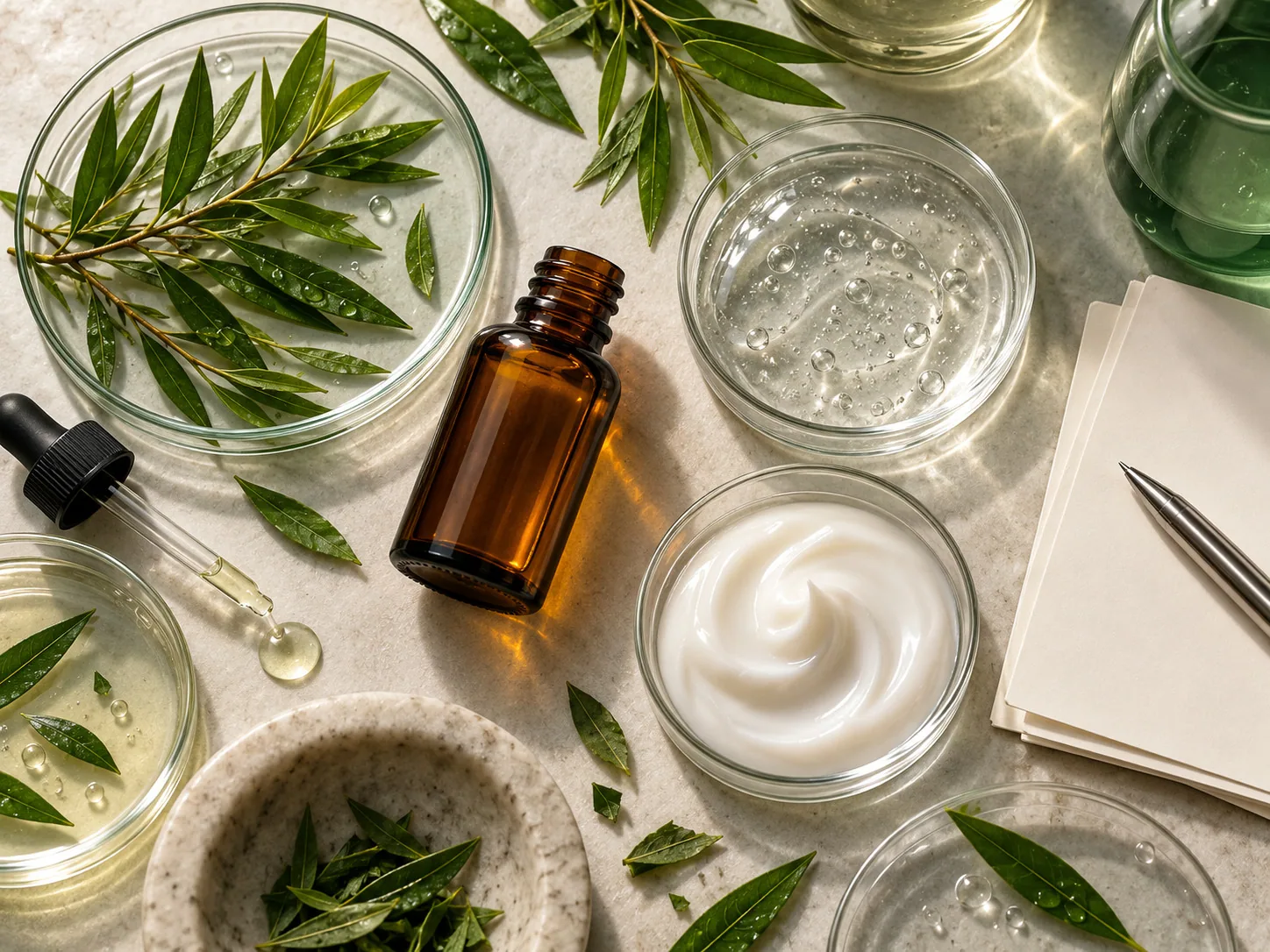
Tea tree oil can oxidize when exposed to air, light, and heat. Earlier research found that some components of oil stored near a window changed, and identified oxidation by-products as major causes of allergic contact dermatitis.[4] The word “natural” does not exempt a product from oxidation or allergy.
Avoid wide-mouthed transparent bottles, storing the product near a bathroom window, and applying undiluted oil directly with a cotton swab. Note the opening date, and discontinue use if the scent or color changes substantially, or if itching, redness, or oozing develops after use.
What should you look for on the label of a tea tree product?
First, the product type and directions
First check whether it is a cleanser or a leave-on cream. Increasing the rinsing time does not make efficacy increase proportionally. Follow the contact time and frequency of use specified by the manufacturer.
Second, testing of the finished product, not just the ingredient
If a product presents only “tea tree oil antibacterial research” and has no human-use study of the actual product, the evidence remains at the ingredient level. Check whether the product name, number of participants, study duration, comparator, and assessment measures have been disclosed.
Third, whether the acne requires treatment
Painful nodules, acne that causes scarring, and recurring inflammation along the jawline are not problems to solve through a competition over cosmetic concentrations. Benzoyl peroxide and topical retinoids, among others, are strongly recommended treatment options in the 2024 acne clinical practice guidelines.[5]
Frequently asked questions
Can I dab undiluted tea tree oil on acne?
It is not recommended. Undiluted oil can increase the risk of irritation and sensitization, and there is no evidence that a higher concentration is more effective than a finished product. Use a finished product designed for the face as directed.
Is a 0.1% cream too weak?
Efficacy cannot be judged by the number alone. The 0.1% figure is the safety condition for face cream assessed by the SCCS; actual efficacy must be confirmed through the overall formulation and human studies.
A one-line verdict before buying
The better question about a tea tree product is not “What percentage is it?” but “Is there evidence for the finished product when this formulation is used on this area for this length of time?” Rather than choosing a product that feels more reassuring as the number rises, choose one that discloses the context behind the number.
Sources
[1] European Commission SCCS · Final Opinion on Tea Tree Oil (CAS/EC No. 68647-73-4) · 2025-10-30
- Source
- [1]European Commission SCCS·Final Opinion on Tea Tree Oil (CAS/EC No. 68647-73-4)·2025-10-30
- [2]Enshaieh et al.·The efficacy of 5% topical tea tree oil gel in mild to moderate acne vulgaris·2007
- [3]Bassett et al.·A comparative study of tea-tree oil versus benzoylperoxide in the treatment of acne·1990
- [4]Hausen et al.·Degradation products of monoterpenes are the sensitizing agents in tea tree oil·1999
- [5]American Academy of Dermatology·Guidelines of care for the management of acne vulgaris·2024-01-31