The key point: Not every brown spot around the eyes and on the cheeks is a “blemish” that needs to be removed. Freckles, solar lentigines, melasma, and post-inflammatory hyperpigmentation develop differently and respond differently to treatment, so they must first be distinguished.
In an interview published by Vogue on October 22, 2026, Jenna Ortega appeared without makeup, with freckles visible across her eyelids.[1] This scene is not evidence that she underwent any procedure. The more useful question for readers is whether visible pigmentation necessarily needs to be removed.
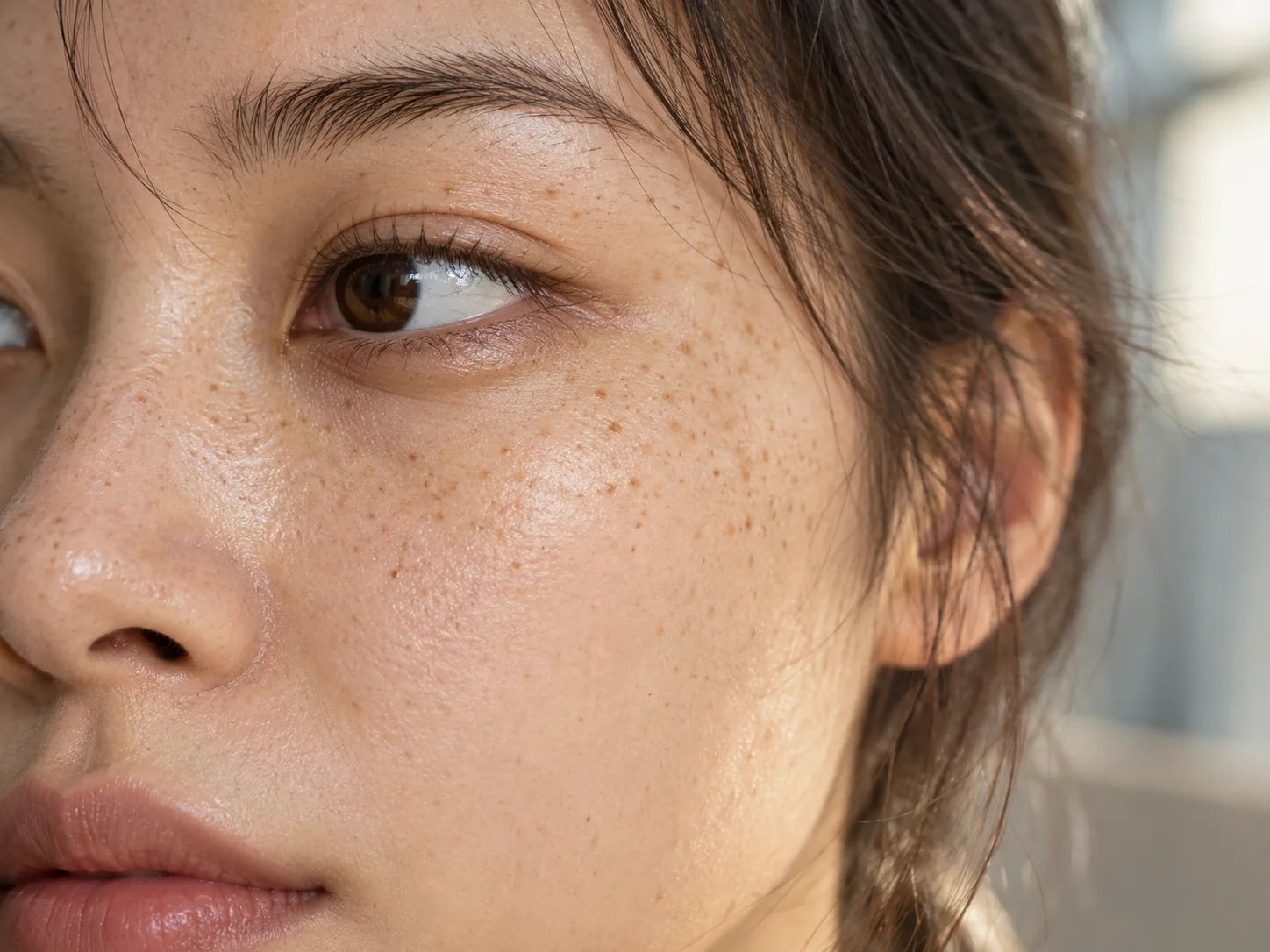
How are freckles different from melasma?
Freckles are generally multiple small, relatively well-defined brown spots scattered across the skin. They may become darker during sunnier seasons and lighter during seasons with less sun. Rather than a major increase in the number of melanocytes, they are understood as a form of increased melanin production.[2]
Melasma often appears symmetrically as broad, irregular brown or gray-brown patches on sun-exposed areas such as both cheeks, the forehead, and the upper lip. The American Academy of Dermatology notes that sunlight, visible light, and hormonal factors can worsen melasma.[3] Unlike freckles, which may be treated one spot at a time, melasma requires attention to overall irritation and recurrence management as well.
What are solar lentigines, commonly called age spots?
Solar lentigines are flat brown spots associated with long-term ultraviolet exposure. They are often larger and longer-lasting than freckles, which can come and go with the seasons from childhood onward.[2] They develop on areas that have received substantial sun exposure, such as the backs of the hands and the face. However, if a spot suddenly enlarges or develops irregular color or borders, other skin conditions should be ruled out before cosmetic treatment.
Post-inflammatory hyperpigmentation is the brown discoloration left behind by acne, dermatitis, or a wound. If the original inflammation is ongoing but pigment lasers are repeatedly used first, the discoloration may become darker again. The diagnostic clues are not just that it looks like a spot, but when it appeared and what inflammation preceded it.
When should you not start by removing it with a laser?
Pigmentation that is sensitive to heat and inflammation, such as melasma, may become darker after initially lightening if a strong energy setting is applied all at once. The risk of post-inflammatory hyperpigmentation should also be considered in darker skin tones. Applying multiple devices under a “blemish package” without a diagnosis can make it difficult to distinguish how each lesion responds.
A 2025 literature review of solar lentigines treatment concluded that improvement has been reported with lasers, light-based treatments, and topical treatments, but that the diversity of study designs, skin types, and device settings makes it difficult to identify a single optimal treatment.[4] More important points of comparison than device names include the diagnosis, wavelength, treatment area, test spots, and post-treatment ultraviolet protection.
What is the order for making pigmentation look less pronounced in daily life?
1. Make morning sun protection routine
Apply a broad-spectrum sunscreen with SPF 30 or higher generously in the morning, and use a hat and shade outdoors. If you have melasma, a tinted sunscreen that also takes visible light into account may be helpful.[3] This step comes first even if you are not receiving pigment treatment.
2. Take photos under the same conditions
Once a month, take front and side photos by the same window at the same time of day. Turn off your phone’s automatic enhancement. This makes it easier to see patterns related to the season, menstrual cycle, and outdoor activity than changes perceived from looking in the mirror every day.
3. Reduce irritation
Do not increase scrubs, strong acids, and retinoids all at the same time. When the skin is stinging and red, restoring the skin barrier takes priority over layering multiple brightening ingredients. If the marks are from acne, treatment to reduce new inflammation comes before pigment treatment.
What treatments may be considered for different lesions?
The official information from Seolleim Dermatology currently lists distinguishing freckles from solar lentigines, 532 nm spot lasers, ruby and alexandrite lasers, IPL, and picosecond pigment treatments.[5] This list confirms what the clinic offers; it is not independent evidence proving the efficacy of each treatment.
For well-defined freckles or solar lentigines, a 532 nm spot laser or a pigment laser at an appropriate wavelength may be considered. When multiple superficial pigmented spots are spread over a broad area, IPL may be an option. Melasma, by contrast, should be managed primarily with ultraviolet and visible-light protection and topical treatment; picosecond or low-fluence lasers should be selected as adjuncts only after assessing the skin’s condition and the risk of recurrence.
Frequently asked questions
Q. Are freckles a health problem that must be removed?
Most typical freckles are a matter of cosmetic preference. However, if a single spot changes quickly or has asymmetry, irregular borders, or multiple colors, have it examined by a dermatologist before considering a cosmetic laser.
Q. Will they disappear permanently after one laser treatment?
That cannot be guaranteed. Even if superficial pigmentation becomes lighter, it may darken again depending on ultraviolet exposure and individual predisposition. Ask about recurrence management and the possibility of side effects, not just the “number of removal sessions.”
Q. What if I have both melasma and freckles?
A safer order is to first reduce irritation in the broadly distributed melasma, then selectively treat well-defined spots. If everything is treated aggressively at once, it becomes difficult to determine which lesion has worsened.
Dr. Kang Jeong-ha’s recommendations
First, use sunscreen with SPF 30 or higher and a hat every day for four weeks, while taking photos under consistent conditions. Second, if you have acne or dermatitis, reduce new inflammation first and do not increase scrubs and high-concentration acids at the same time. Third, record separately whether a single spot is changing and whether a broad patch becomes darker with the seasons.
Treatment priorities depend on the diagnosis. For well-defined freckles or solar lentigines, consider a 532 nm or lesion-appropriate pigment laser as the first option, including a small test spot. If superficial pigmentation is spread over a broad area, consider IPL as a second option, while confirming the possibility of erythema, crusting, and post-inflammatory hyperpigmentation, as well as the recovery schedule. If melasma is the main concern, establish light protection and topical treatment first; choose picosecond or low-fluence lasers as adjuncts only after discussing recurrence and the risk of hyperpigmentation. Finding the name of your pigmentation comes before pursuing a “clear face”—and is the fastest place to start.
Sources
[1] Vogue · Jenna Ortega Is No Longer a Girl Interrupted · 2026-10-22
[2] DermNet · Brown spots and freckles · 2018-10
[3] American Academy of Dermatology · Melasma: Overview · 2022-02-15
[4] PMC · Treatment of Solar Lentigines: A Systematic Review · 2025

Engaging Skin Stories for Healthier Skin
Drawing on 16 years of experience running Seolleim Clinic in Gangnam and expertise in dermatological procedures, we explain practical skincare methods for everyday life, along with approachable and engaging stories about dermatology inspired by celebrities, public figures, and television. Through professional knowledge and experience, we hope to help your skin look healthier and more radiant. We hope this series broadens your understanding of skin and helps you discover ways to take better care of yourself.
Medical Director Kang Jeong-ha (Seolleim Clinic Gangnam)