Would copying Amal Clooney’s new layered cut make everyone’s hair look fuller? No. The key to this look isn’t having “lots of layers,” but where the weight has been removed—and where it has been left in place. If your hair is fine, it is safer to start the longer layers below the chin and leave enough weight at the bottom so it does not look see-through.
At the fifth annual Albies in London on October 9, 2026, Amal Clooney debuted a shorter length than before, ends that looked lightly refined with a razor, face-framing layers, and soft waves. Hairstylist Dimitris Giannetos told Vogue that he drew on both Sophia Loren’s volume and Kate Moss’s undone texture.[1] Rather than copying retro waves outright, he modernized the contrast between “polished roots and loose ends.”
Why do razored layers make hair look fuller?
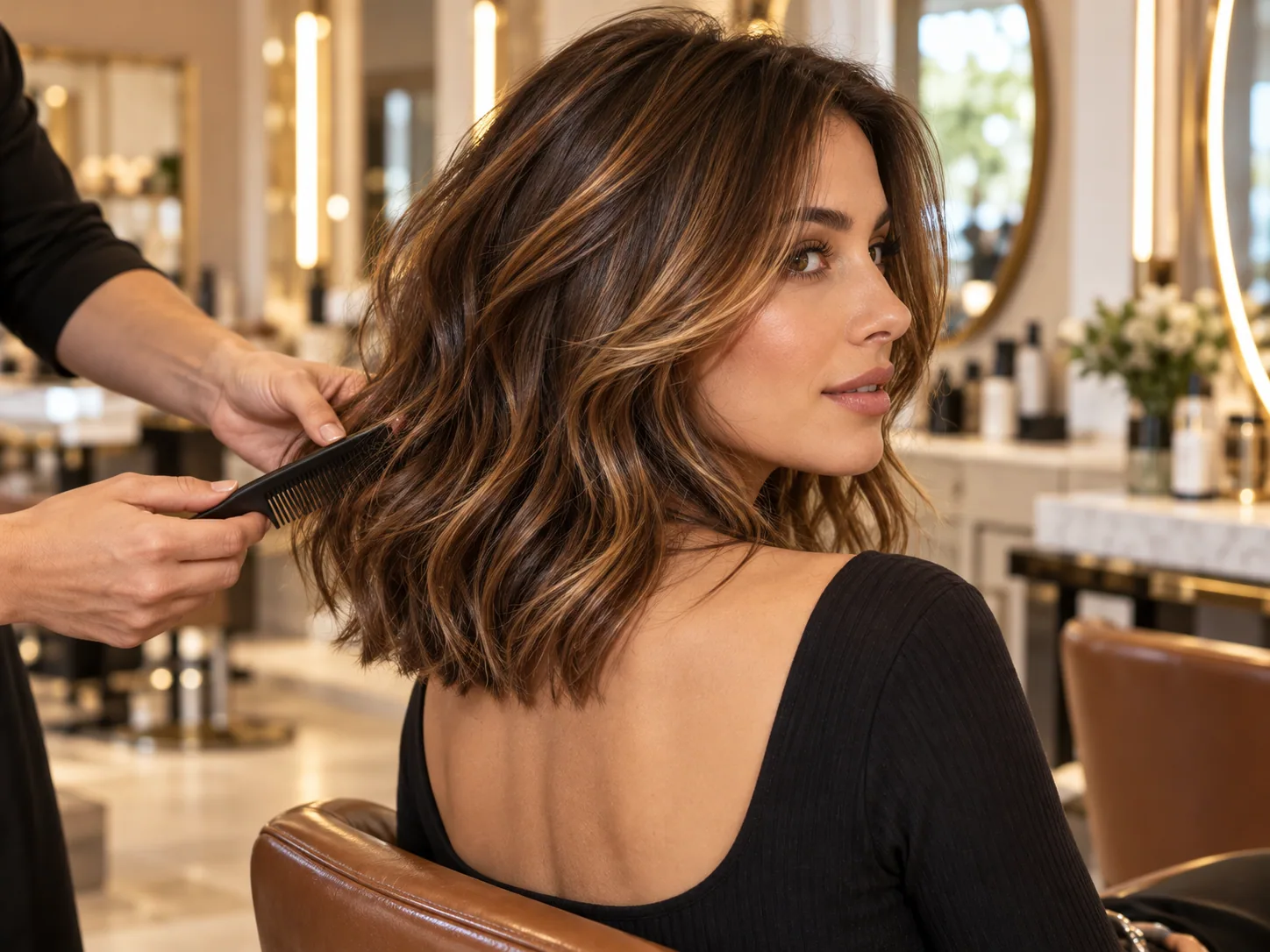
Rather than cutting a distinct horizontal line with scissors, razored layers create movement by subtly varying the thickness of the ends. When the hair forms waves, the shorter and longer layers catch the light from different directions, making what was once a single mass appear multi-layered. It is less an increase in “volume” than a visual effect in which the same amount of hair creates more contour and shadow.
The comparison that matters is not the number of layers, but the transparency of the final 5–7 cm. Over-thinning the ends may look light in photos, but in everyday life it can make them appear stringy. At the salon, it is more precise to say, “I want movement, but please leave enough weight that the ends don’t look see-through when my hair is tied back.”
Where should layers begin on fine versus thick hair?
If your hair is fine and low-density, it can help to place the shortest face-framing layer around the cheekbone or below the chin, then connect the layers at the back down toward the collarbone. If you create too many short layers from the crown, the hair may look buoyant right after a blow-dry but begin to look split and scraggly at the ends over time.
If your hair is thick and dense, reducing weight below the ears and inside the back of the head helps keep the waves from forming a flat triangle. However, if your hair is tightly curly or prone to frizz, the layers should be determined after checking the amount of shrinkage in its dry state. Even if you show the same reference photo, explain how much shorter your hair becomes when dry to get a closer result.
How can you create “undone but polished” waves at home?
Lift the roots first, and avoid curling the ends too much. Apply a lightweight heat protectant from the mid-lengths to the ends on wet hair, then dry it until it is 70–80% dry. Curl only two or three face-framing strands loosely away from the face, and alternate the direction of the remaining thick sections. Once the hair has cooled, loosen it with your fingers so the boundaries between the curls disappear, leaving a relaxed texture.
Using too much volumizing spray and dry shampoo at the same time can make fine hair look clumped and dull instead. Use a small amount of just one product at the roots, and add shine only to the ends for a lighter look both in photos and in everyday life. The American Academy of Dermatology recommends using low or medium heat and a heat-protective product, as excessive heat can damage hair.[2] Rather than creating fully styled waves every day, refreshing only the area around the fringe can save both your hair and your time.
What should you say and bring to the salon?
Bring photos showing the side and back as well as one from the front. During the consultation, explain, in order: ① where you want the shortest layer to fall, ② the minimum length you need to be able to tie your hair back, ③ how much weight you want left at the bottom, ④ the size of the hot tools you normally use, and ⑤ how much time you can spend styling. These five points will produce a more accurate result than simply saying, “Like Amal Clooney.”
Frequently Asked Questions
Does a layered cut actually increase the amount of hair?
No. Layers and waves create light and shadow, making the hair appear fuller, but they do not increase the number of hairs. If your part suddenly looks wider or you are shedding more than usual, a scalp and hair-loss evaluation should take priority over a haircut.
Do I need to use a curling iron every day to maintain this style?
Not necessarily. If the cut is right, you can create movement simply by refining the face-framing pieces with a large round brush or Velcro rollers. If you use hot tools, it is better to work briefly on only the strands that need it, at a low or medium temperature.[2]
DERME VERDICT
The appeal of Amal Clooney’s look lies less in its dramatic curls than in the balance of “removing weight without leaving the ends empty.” For fine hair, use low, long layers as a guide; for thick hair, remove weight from within; and for curly hair, check the dry length first. Creating the same movement in your own hair, rather than copying the photo, is the more polished choice.