The takeaway: Stress management and psychological interventions may help reduce itch and scratching behavior in atopic dermatitis, but they cannot replace moisturization, topical treatment, or systemic treatment for skin inflammation. A 2026 systematic review and meta-analysis reported that 17 of 20 randomized controlled trials involved patients with atopic dermatitis, and that self-reported itch decreased by a small average amount after psychological interventions.[1]
Psychodermatology is not a field that blames skin problems on the mind. It takes an approach that considers the pathways through which stress, sleep, emotions, habits, and skin symptoms affect one another. In particular, behavioral strategies that interrupt the “itch–scratch cycle”—itching leads to scratching, which further damages the skin barrier and causes more itching—are important.
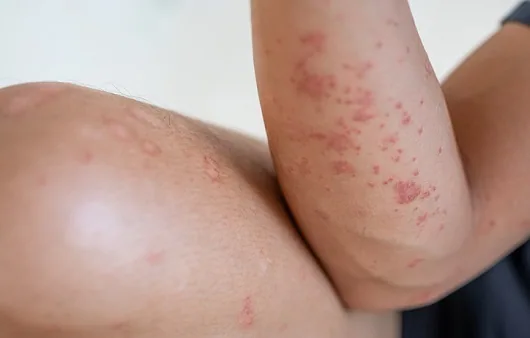
Does stress directly cause atopic dermatitis?
That cannot be stated definitively. A 2026 review of the skin–brain axis summarized the possibility of two-way connections through neural, immune, hormonal, and microbial pathways, but these biological links do not establish that an individual’s atopic dermatitis is “because of stress.”[2] Another 2026 systematic review reported associations between stress and trauma and the onset and severity of several skin diseases, but the study designs do not allow correlation to be described as causation.[3]
How much can psychological interventions reduce itch?
In a 2026 meta-analysis, psychological interventions showed an improvement of approximately Hedges g −0.37 in self-reported itch immediately after treatment and approximately −0.59 at follow-up.[1] Hedges g is a value used to standardize and compare differences between two groups; −0.37 is generally close to a small effect. In other words, the finding does not mean that “controlling your mind alone cures the skin,” but that psychological interventions may help with symptom control when added to existing skin treatment.
In September 2026, a randomized controlled trial evaluating a psychodermatology education module for patients with atopic dermatitis was also published.[4] However, one study alone cannot establish that any particular program is effective for every patient. In practice, symptom severity, mental health status, and access to treatment should be considered together.
What can you do at home to manage the “itch–scratch” cycle?
First, record when and under what circumstances itching occurs for 1–2 weeks to identify patterns. Second, keep your nails short and choose skin-safe alternative behaviors for moments of unconscious scratching, such as applying a cold compress, clenching and unclenching your hands, or reapplying moisturizer. Third, reduce clear personal triggers before bed, such as overheating, sweating, and rough fibers. Fourth, brief breathing or relaxation exercises, cognitive behavioral therapy (CBT), or habit reversal training can be used with a professional when you feel tense.
When should dermatologic treatment take priority over self-management?
If the skin is oozing or becomes rapidly red and hot, if pain or fever is present, or if itching severe enough to prevent nearly all sleep persists, infection or moderate-to-severe inflammation should be assessed. In these situations, psychological interventions are an adjunct, not a substitute for anti-inflammatory or infection treatment.
Frequently Asked Questions
Can reducing stress cure atopic dermatitis?
There is no evidence to say that it can. Research on psychological interventions mainly indicates the possibility of improvements in itch, scratching behavior, and quality of life.[1] Long-term management of skin inflammation requires medical treatment appropriate to the severity of the disease.
Can I reduce my medication if I only meditate?
It should not be used as a basis for reducing medication on your own. Meditation and relaxation are just some of the ways to address the stress response; any changes to prescribed treatment should be decided with a healthcare professional based on the skin’s condition and response to treatment.
Is it best to simply resist scratching when you itch?
Telling someone to resist through willpower alone is not realistic. It is more practical to pair skin treatment that reduces itch intensity with alternative actions prepared in advance for moments when you would otherwise scratch.
DERME VERDICT
For atopic dermatitis itch, stress management is not “treatment that looks for the cause in the mind,” but an adjunctive strategy for reducing the itch–scratch cycle. The 2026 evidence shows a small but meaningful average effect.[1] The most realistic approach is to treat skin inflammation appropriately while also applying behavioral strategies involving sleep, stress, and habit reversal.
- Source
- [1] PubMed · Effects of Psychological Interventions on Itch, Scratching, and Excoriations: A Systematic Review and Meta-analysis · 2026-02-04
- [2] PubMed · Skin-Brain Axis: Biological Foundations and Clinical Implications · 2026
- [3] PubMed · Stress and Trauma in Inflammatory Skin Disease: Systematic Review · 2026-06
- [4] PubMed · Effectiveness of Psychodermatologic Educational Modules on Atopic Dermatitis Patient Outcomes: A Randomized Controlled Trial · 2026-09-11