The key point: If symptoms are urgent—such as difficulty breathing or impaired consciousness—call 119 first. For non-emergency travel interpretation and information, use 1330; for infectious-disease-related guidance, use 1339. Before returning home, obtain separate nighttime contact instructions and treatment records from the clinic where the procedure was performed.[1]
Overseas patients who have undergone a dermatology procedure in Seoul or Gangnam may easily assume that multilingual consultation means they are also prepared for nighttime emergencies. But interpretation at reception, consultation with medical staff, and emergency contact after hours are separate services. Confirm each of the three separately when making the booking.
Which symptoms call for 119 first?
If there is a suspected immediate threat to life or bodily function—such as difficulty breathing, sudden swelling of the lips or tongue, reduced consciousness, collapse, or chest pain—call 119 rather than waiting for a reply on the clinic’s KakaoTalk channel. The Korea Tourism Organization’s official guidance lists 119 for both fires and medical emergencies.[1]
When giving your location, have the accommodation’s address in Korean, building name, floor, and room number ready. Describe your current symptoms before naming the procedure. “I had fillers” is less important than “I’m short of breath and my lips are swelling rapidly.” If you are alone, asking the front desk to call 119 may be faster.
How are 1330 and 1339 different?
1330 is the Korea Tourism Organization’s travel hotline. It provides travel information in multiple languages, including Korean, English, Japanese, and Chinese.[1] In a non-life-threatening situation, it can serve as a supplementary resource for finding a nearby medical facility or obtaining assistance with transportation and interpretation, but it is not a medical service that assesses emergency severity.
1339 is listed in official travel guidance as an emergency contact for infectious diseases.[1] Another Korea Tourism Organization FAQ also describes it as a number that can help connect callers with a nearby hospital for medical emergencies.[2] Because the roles assigned to the number are described differently on different situation-specific guidance pages, it is safer to use 119 consistently for urgent symptoms and 1339 as a supplementary resource for non-emergency situations requiring infectious-disease or medical-facility information.
When should you contact the clinic where the procedure was performed?
If pain, swelling, blisters, or color changes exceed the expected range but your breathing and consciousness are stable, contact the clinic first. Do not send only a one-line message asking, “Is this a normal reaction?” Include the procedure time, treatment area, product or device name, time the symptoms began, rate of change, current medications, and photographs.
The appropriate response differs for fillers, lasers, radiofrequency, and injectable procedures. If the clinic tells you to wait based only on photographs, ask for specific criteria: what changes over the next few hours should prompt you to contact them again or go to an emergency department? Before contacting your regular doctor in your home country, secure records of the product, energy settings, and dose used locally.
What “nighttime aftercare” questions should you ask before booking?
1. Who responds outside clinic hours?
Ask whether the call reaches an automated main-number message, an interpretation coordinator, or an on-call medical professional. Even if the clinic has a messenger account, do not treat it as an after-hours contact channel unless a response time is guaranteed.
2. Can you receive English medical records the same day?
At a minimum, you need the procedure name, treatment area, date, product name and lot number or device name, settings used, prescribed medications, allergies, and the clinic’s contact details. A cost estimate and medical records are different documents.
3. Is there enough time between the recovery period and your departure date?
“One day of downtime” is ambiguous: Does it mean the period during which redness is visible, when makeup is allowed, or when flying is allowed? Ask in terms of the practical milestones that matter to you. Scheduling the final procedure just before departure eliminates time for local reassessment.
A five-minute checklist if symptoms appear at night
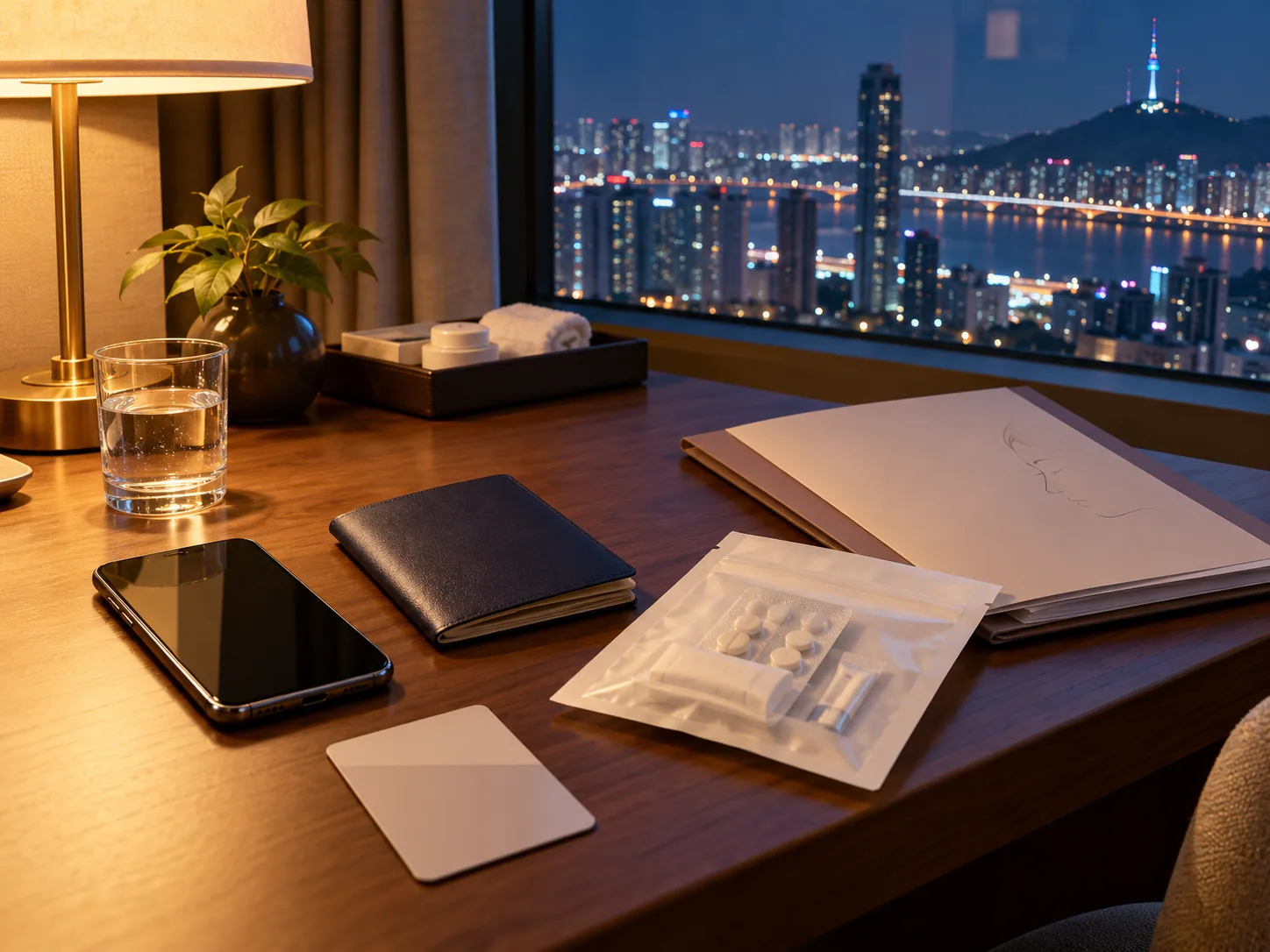
First, check your breathing, consciousness, and whether the condition is worsening rapidly. Second, if the situation is urgent, call 119 and ask the accommodation staff to provide the address in Korean. Third, if you are stable, take photographs in bright light from the same angle. Fourth, retrieve your treatment records and medication packaging. Fifth, send the time the symptoms began and how quickly they are changing to the clinic’s after-hours number.
Frequently asked questions
Q. Will 1330 provide medical interpretation if I call?
1330 provides travel information and multilingual guidance, but it does not replace a medical professional’s diagnosis.[1] Understand it as a supplementary channel for connecting with a clinic or international healthcare center in non-emergency situations; in an emergency, call 119.
Q. What should I ask my travel insurer?
Before the procedure, confirm whether complications after cosmetic procedures, emergency-department care, prescription medication, follow-up treatment, and the cost of changing your return trip are covered. Do not assume that a broad category labeled “medical expense coverage” includes complications from elective cosmetic procedures.
Q. Is aftercare included in the price of a Seoul procedure?
It varies by clinic. When requesting a quote, ask separately about the cost of follow-up visits, photo consultations, prescriptions, emergency treatment, interpretation, and issuing records. For travelers, the structure that allows them to reconnect with the clinic if something goes wrong may be a more important cost consideration than the lowest one-time price.
DERME VERDICT | Arrange your contact network before your departure date
Aftercare in medical tourism is not a service that begins once the procedure is over. It begins when you book, at the moment you establish the after-hours contact person, English-language records, and emergency transportation route. Save 119, the clinic’s after-hours number, and your insurer in your phone, and take a screenshot of your accommodation’s address in Korean. If an adverse reaction occurs, the most costly loss may not be the cost of treatment, but the time lost through delayed judgment.
Sources
[1] Korea Tourism Organization · Emergency Situations · checked September 11, 2026
[2] Korea Tourism Organization · VISITKOREA FAQ: Emergency medical contact · date not specified